Patient Data Exposure When Healthcare Workers Use Consumer AI
Physicians are adopting AI faster than hospitals can govern its patient data risks.
Patient data exposure through consumer AI tools isn't a hypothetical risk that healthcare organizations need to plan around someday. It's already happening, at scale, built into the way these tools are designed to work. The gap isn't between careless employees and careful ones, it's between how fast clinical staff have adopted AI and how slowly the compliance infrastructure meant to govern it has moved.
The numbers on adoption alone should make that clear. Physician use of AI in practice nearly doubled between 2023 and 2025, climbing from 38% to 66%, according to TechTarget's analysis of AI and HIPAA compliance. Separately, Netskope Threat Labs found that 88% of healthcare organizations now use generative AI in some form. That's not a niche behavior confined to early adopters anymore. It's close to universal.
None of this is happening out of recklessness. Wolters Kluwer's research points to burnout, staffing shortages, and administrative overload as the real drivers behind why staff reach for whatever tool gets the job done fastest. Among workers using unapproved AI tools, 45% said speed was the primary motivator, and more than half of administrators said the same. Roughly 40% of administrators and 27% of providers pointed to better functionality, or simply the absence of any approved alternative. So, the picture isn't one of workers ignoring the rules. It's one of workers solving a real problem with the only tool in front of them.
Governance has not caught up. Only 29% of providers say they're even aware of their organization's core AI policies, per the Wolters Kluwer Health survey. And the regulatory landscape doesn't make catching up easy: there's no single federal AI law covering healthcare. Organizations have to navigate HIPAA, HITECH, a patchwork of state laws, and shifting agency guidance all at once. Forvis Mazars counted more than 250 AI-related bills introduced across 46 states in the past year alone, as of January 2026. That's not a stable compliance target. That's a moving one.
The framing that follows here treats this as a structural problem, not a behavioral one. Individual judgment matters, but no amount of individual caution changes how a consumer AI tool is built to collect and retain data. That's the gap this piece is walking through, section by section.
What "shadow AI" looks like inside a healthcare organization
Shadow AI, in a healthcare setting, means staff using AI tools that haven't been vetted or approved by the organization. It's rarely malicious. Mostly it looks like someone trying to save twenty minutes on a task nobody redesigned the workflow around.
Wolters Kluwer's survey, with 518 respondents split evenly between administrators and providers, gives the clearest snapshot available. Fully 57% had personally used or witnessed shadow AI at their organization. Just under 20% admitted to using an unsanctioned tool themselves, and more than 40% said they knew a colleague who had. One in ten had used an unauthorized AI tool for a direct patient care task, not administrative cleanup, actual clinical use.
What does this look like on a Tuesday afternoon? A front desk coordinator pastes chart notes into a free AI tool to tidy up a referral letter before lunch. A medical assistant runs a long referral through a consumer chatbot to summarize it before handing it off to the provider. A clinician, behind on notes and running late for the next patient, types symptoms into a personal AI account just to get a draft down faster. None of these people think they're creating a compliance incident. They think they're keeping the day moving.
Harley Sugarman of Anagram Security, writing in Medical Economics in July 2026, makes the structural point that AI has expanded the surface area of where patient data can live. It used to move through systems and protocols with defined boundaries. Now it can end up in any interface a worker happens to have open, any interface a worker happens to have open.
Some of this is trending in the right direction. Netskope's data shows 71% of healthcare workers still using personal AI accounts for work, down from 87% the year before. That's real progress, but it's still nearly three out of four workers routing information through accounts nobody in compliance has ever reviewed.
And the gap between the 20% who admit to shadow AI use and the 57% who've witnessed it matters too. That's not a small discrepancy. It suggests organizational awareness of the problem runs far ahead of individual willingness to own up to it, which means the real prevalence is likely higher than even the survey numbers suggest.
Why consumer AI tools are structurally incompatible with protected health information
Consumer AI products are built to collect data and use it to improve the product. That's the business model. It's also exactly the opposite of what HIPAA demands from anything touching protected health information.
Netskope found that 96% of healthcare organizations use apps that draw on user data for model training, which means PHI can end up feeding systems with no clear boundary on who eventually sees it or how it's used. Depending on the specific product and its settings, that data might sit in storage indefinitely, get reviewed by human staff for quality checks, or get folded into training data for the next model version. None of those outcomes are things a healthcare compliance officer can sign off on with a straight face.
The technical gaps run deeper than data retention policy. Consumer tools generally have no role-based access control, so a physician and a front-desk receptionist using the same tool have identical access to whatever gets typed into it. There's no HIPAA-standard audit trail, no activity log a compliance team could pull during an investigation, and no built-in mechanism to stop unauthorized disclosure once information is in the system. Standard consumer-tier ChatGPT cannot be configured to meet HIPAA's access control requirements, that's not a settings problem but an architecture one.
Something administrators tend to miss is that bringing in a third-party AI tool doesn't just add one vendor to the compliance chain. It adds the underlying language model, whoever hosts that model, and any subprocessors involved in running it, each a place where something can go wrong and each needing its own scrutiny.
Even stripping identifying details doesn't fully solve the problem. De-identification is not an absolute shield, and treating it as one is a mistake. Stripping obvious identifiers doesn't guarantee that information shared with large platforms can never be linked back to an individual.
Maybe the most unsettling part is the invisibility. There's no system alert when someone pastes a chart note into a chatbot, no log entry, no ping to the compliance officer's inbox. The industry already averages 93 days to detect a conventional data breach, according to patient-protect.com, and a PHI disclosure through a consumer AI tool may never become visible internally at all. Nobody's looking for it because nobody built a system that watches for it.
HIPAA's requirements aren't vague on any of this. What's actually uncertain, and what trips organizations up, is whether staff and administrators understand which tools genuinely meet those requirements and which only look like they do.
What HIPAA requires and where consumer tools fall short
The Business Associate Agreement is the hinge everything turns on. Per Medical Economics' coverage, HIPAA exposure happens the moment PHI gets entered into a public LLM that isn't a covered entity and hasn't signed a contract, regardless of what happens to that data afterward. Even if nothing downstream ever goes wrong, the disclosure itself is the violation.
HIPAA's minimum necessary standard adds another layer: PHI can only be shared to the extent a specific task actually requires it, and handing PHI to any vendor, AI included, counts as a disclosure that needs to be permitted and, in most cases, backed by a signed BAA. The Security Rule then piles on its own list: access controls, audit logging, encryption, a documented risk analysis. Consumer-tier AI tools have none of it.
Where does that leave the major players? Per HIPAA Journal and valuestreamai.com, ChatGPT Free, Plus, and Team are not HIPAA compliant. OpenAI won't sign a BAA for those tiers, and PHI is explicitly off-limits. ChatGPT Enterprise, ChatGPT for Healthcare, and ChatGPT for Clinicians can become HIPAA-capable, but only once a BAA is actually in place, negotiated through sales for Enterprise and Healthcare tiers. Signing up for the product doesn't confer compliance on its own; the paperwork has to happen first.
ChatGPT for Healthcare launched January 8, 2026, as an enterprise product, and it's already rolling out at Boston Children's Hospital, Cedars-Sinai Medical Center, HCA Healthcare, UCSF, AdventHealth, Baylor Scott & White Health, Memorial Sloan Kettering Cancer Center, and Stanford Medicine Children's Health, according to OpenAI. ChatGPT for Clinicians followed in April 2026, offering free documentation and research tools to verified physicians. Separately, ChatGPT Health, a consumer-facing wellness product launched in 2026, comes with stronger privacy protections than the free consumer tiers, but it still runs on consumer-grade terms rather than a covered-entity relationship, per HIPAA Journal. Better privacy language is not the same thing as HIPAA coverage.
Other vendors follow a similar split. Microsoft 365 Copilot falls under existing Microsoft 365 BAAs for eligible enterprise customers, and Anthropic offers a BAA on eligible enterprise Claude plans. But the free tiers from OpenAI, Anthropic, and Google's Gemini all explicitly exclude BAA eligibility. No mainstream free AI tool comes with one. None.
Worth restating: whether a tool uses AI is not the question. A BAA has to be actually signed, and the technical safeguards, access control, audit logs, encryption, have to be actually in place. Both conditions have to be true at once. Either one alone isn't enough.
And the regulatory floor keeps shifting. The Colorado AI Act, effective June 2026, adds governance and disclosure requirements specifically for high-risk AI systems involved in consequential healthcare decisions, according to Forvis Mazars. Compliance in this space isn't settling into a stable set of rules. It's getting more layered every year.
What the data breach record shows about where this is heading
The breach numbers were already grim before shadow AI became a mainstream habit. As of January 31, 2026, HHS OCR has recorded 7,419 healthcare data breaches affecting more than 935 million individuals, a figure that outstrips the population of the country several times over when you account for people appearing in multiple breach records.
There's a silver lining buried in the trend line: 2025 saw cyberattacks compromise almost 57 million medical records, down sharply from 259 million in 2024 and 138 million in 2023, according to HHS OCR and Chartis data. Fewer records exposed is genuinely good news. But that improvement predates the full weight of shadow AI hitting the breach statistics.
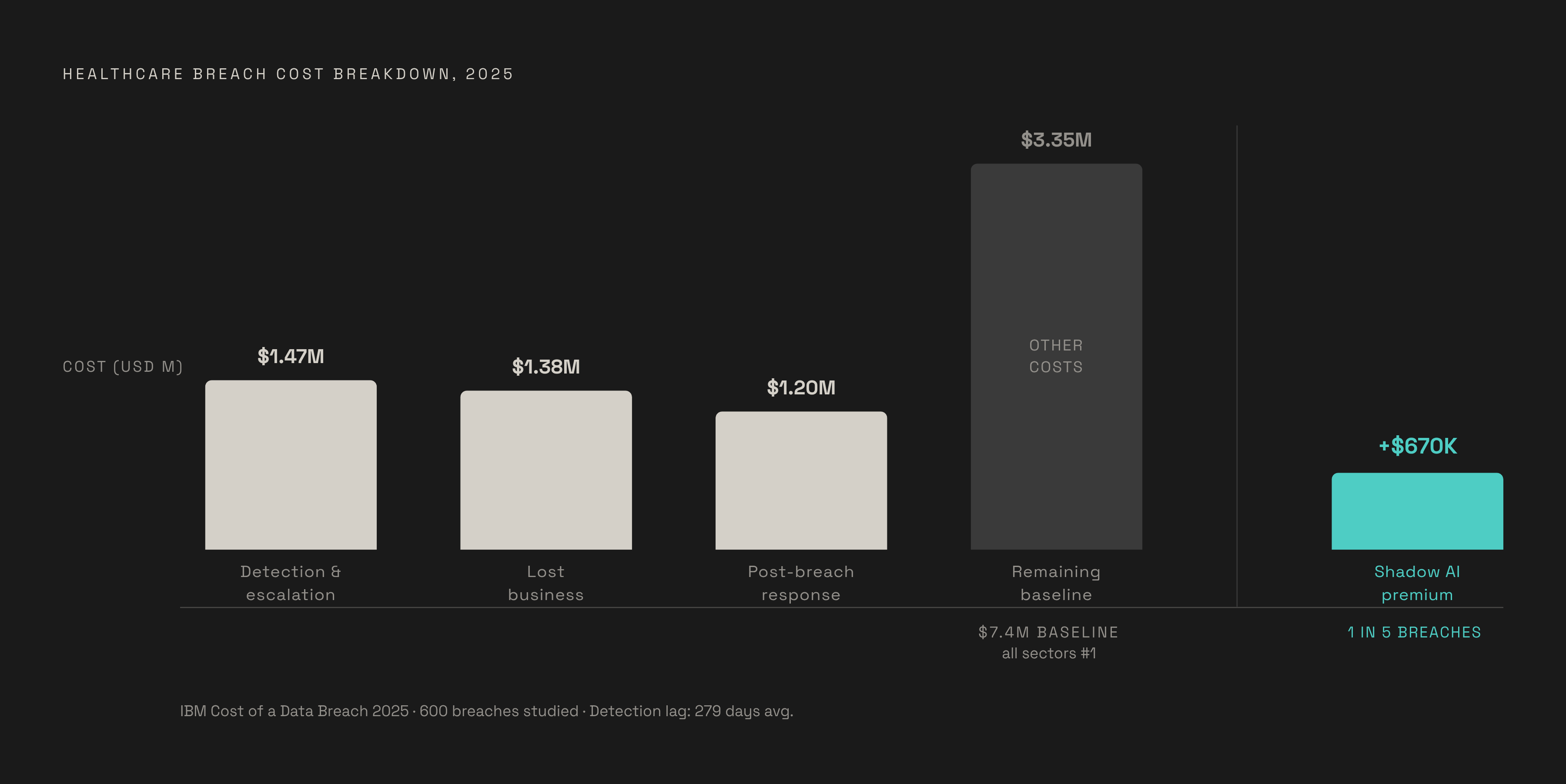
IBM's 2025 Cost of a Data Breach Report gives an early read on where this is going, and it's not encouraging. Shadow AI involvement added an average of $670,000 to the cost of a breach and showed up in one out of every five of the 600 breaches IBM studied. Healthcare, meanwhile, already carries the highest average breach cost of any sector, topping $7.4 million in 2025 per IBM. And 97% of organizations that suffered an AI-related security incident lacked proper AI access controls beforehand, which suggests the exposure was foreseeable, not freak.
Breaking down where that $7.4 million actually goes matters for anyone running a budget. Detection and escalation alone average $1.47 million, lost business costs run $1.38 million, and post-breach response adds another $1.2 million, according to HIPAA Journal. These aren't regulatory fines sitting off in a separate column, they're operational costs that hit the organization's day-to-day finances directly.
Detection speed compounds all of it. Healthcare organizations average 279 days to detect and contain a breach, roughly five weeks slower than the global average across industries, according to axis-intelligence.com. And a shadow AI disclosure, given the total absence of logging most consumer tools offer, may never get detected internally at all.
One incident from the past year illustrates how the chain involving an AI vendor itself becomes a breach vector. A healthcare organization suffered a breach, reported to a state attorney general's office in January 2026, that compromised the protected health information of millions of individuals at an AI-powered vendor handling insurance enrollment and benefits administration. The exposed data included names, addresses, emails, phone numbers, dates of birth, government identification numbers, health insurance enrollment records, medical record numbers, diagnoses, lab results, prescriptions, medical images, physician names, and insurance claims information, according to an industry publication tracking the breach. As of early 2026, it ranked among the largest healthcare breaches on record. This wasn't a rogue employee pasting notes into a chatbot. It was a vendor relationship, the exact kind of subprocessor exposure Sugarman warns about, failing at scale.
And when regulators do step in, the penalties aren't trivial. HIPAA civil monetary penalties range from $145 to $2,190,294 per violation, according to valuestreamai.com. OCR closed 21 cases with financial penalties in 2025 alone, collecting $8.33 million total, with an average settlement of $1.2 million per case. A violation gets counted per patient record, not per incident. A single shadow AI disclosure touching thousands of records isn't one violation. It's thousands.
Why stolen medical records are worth far more than stolen financial data
Why does any of this matter more than a routine credit card breach? Because the underlying asset is worth dramatically more to whoever steals it. A complete medical record sells for somewhere between $260 and $310 on dark web markets, according to totalassure.com, up to 80 times the value of a stolen credit card number, which typically fetches $5 to $15.
The reason comes down to permanence. A stolen credit card gets canceled with a phone call, and the exposure ends there. PHI can't be revoked the same way; a diagnosis, a government identification number, or a medical record number tied to a real person doesn't expire or get reissued. Medical records also open doors financial data doesn't: insurance fraud, and medical identity theft, where someone else receives treatment under a stolen identity. Combine that with the fact that a single record often bundles a government identification number, a home address, and detailed diagnostic history all in one place, and you get raw material for long-term identity theft that's far more durable than what a bank card number alone provides, per a data breach tracking site.
That reframes what's actually at stake in a shadow AI disclosure. It's not merely a compliance violation that appears on a regulatory filing somewhere. It's handing an attacker a high-value, effectively permanent asset tied to a real, identifiable patient.
And the burden doesn't fall evenly. The organization writes a check for the fine and absorbs the breach response costs, then moves on. The patient lives with the exposure indefinitely, often without ever knowing it happened, since medical identity theft is notoriously hard to detect and even harder to untangle once discovered.
The costs don't stop at the patient either. Nearly half of breached healthcare organizations raise prices to cover the resulting costs, and close to a third raise them by 15% or more, according to HIPAA Journal. So the harm doesn't stay contained to the breach itself. It works its way back into what patients pay for care, quietly, months or years down the line.
What a governance response requires in practice
Writing a policy and hoping staff follow it doesn't work, and the evidence backs that up. Sugarman's July 2026 piece in Medical Economics makes the point bluntly: clinicians under real time pressure will bypass a sanctioned tool that's slower or clunkier than the alternative sitting on their phone. What actually changes behavior is defaults that make the safe option the easy option, guardrails baked into the workflow, and training that speaks to actual clinical tasks rather than legal boilerplate nobody reads past the first paragraph.
A practical starting point looks less like a ban and more like an audit. Find out which tools staff are actually using day to day, then negotiate security assurances and BAAs around those tools where possible, aligning the organization's governance with the tools that are already solving a real productivity problem rather than pretending the problem doesn't exist. Sugarman frames this as the more realistic path forward, compared to issuing a blanket prohibition that staff will quietly route around anyway.
Vendor assessment also needs to go deeper than it traditionally has. Sugarman's point about subprocessors applies here directly: a credible review has to map not just the AI vendor itself, but the underlying model, wherever it's hosted, and any subprocessors in the chain, along with where the data physically sits. Standard SaaS due diligence checklists weren't built for this and don't catch it.
Forvis Mazars, writing in January 2026, lays out what the broader infrastructure looks like in practice. It starts with a genuinely multidisciplinary AI governance team, clinical staff, legal counsel, compliance officers, data scientists, and ethicists all at the same table, not compliance operating in isolation from the people actually using the tools. Contracts need explicit terms on data usage, breach response, and audit rights spelled out rather than assumed. And the monitoring can't be a one-time review at signing, it needs continuous auditing across the full lifecycle of the tool, from deployment onward.
Some technical controls are already gaining real traction. Data Loss Prevention tools are now used by 47% of organizations specifically to manage which generative AI applications staff can access, according to Netskope's Generative AI Cloud and Threat Report, and real-time alerts have shown genuine success at changing behavior in the moment, catching a risky action before it becomes a breach rather than after.
But how much of this gap can policy and monitoring actually close? Retrofitting compliance onto a tool built for a consumer market has real limits, since the underlying architecture, the thing collecting and retaining data by default, doesn't change just because a BAA gets signed on top of it. The more durable answer is AI built from the ground up with different assumptions: patient data that never leaves a controlled environment, that isn't used to train future models, with no external data collection built into the design at all. That's privacy as a structural property of the system, not a policy layered on afterward and hoped into compliance.
Workers reaching for consumer AI tools aren't the problem here. They're responding, reasonably, to real pressure with the tools available to them. The sustainable fix isn't asking them to want less capability. It's giving them AI that doesn't force a choice between getting the work done and keeping patient data where it belongs.
Sources
- What are the data security risks of using AI tools in healthcare? | Medical Economics
- How the Rise of Artificial Intelligence Affects Patient Data | Forvis Mazars US
- Healthcare workers' AI use risks patient data, Netskope report warns - Outsource Accelerator
- Health care workers are leaking patient data through AI tools, cloud apps | Medical Economics
- 5 HIPAA violations caused by improper AI use
- Health system size impacts AI privacy and security concerns | Wolters Kluwer
- Shadow AI: A hidden risk to healthcare | Wolters Kluwer
- netskope.com