AI Adoption in Law Enforcement and the Privacy Implications for Suspects
Agencies deploy AI faster than oversight can catch up, leaving suspects vulnerable.
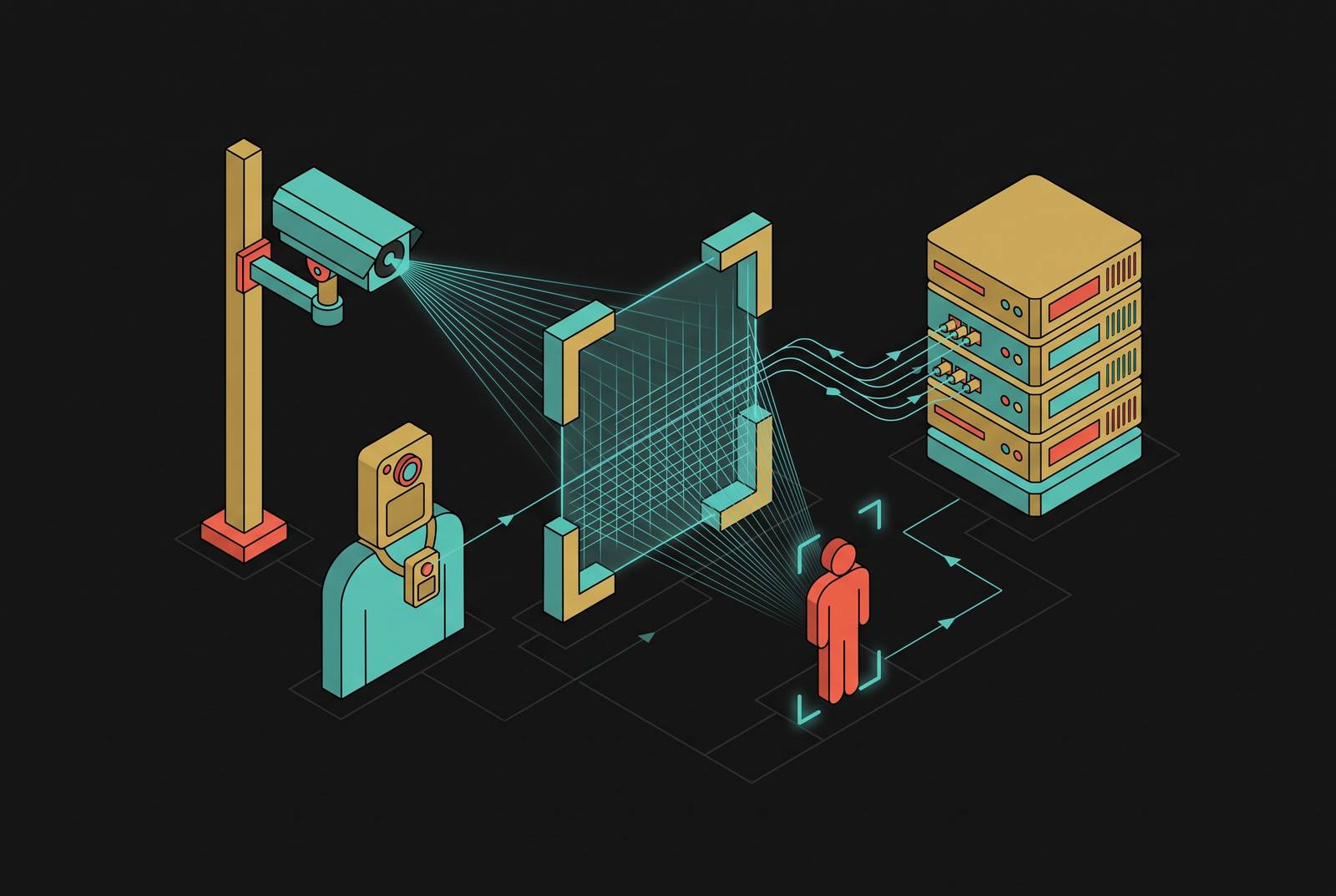
Law enforcement's use of artificial intelligence has grown faster than any system built to watch over it, and the distance between what agencies can now do and what the law says they may do keeps widening. This piece traces that gap from its broadest federal numbers down to specific tools, specific arrests, and one city's attempt to turn years of illegal surveillance into a permanent legal right.
How law enforcement AI adoption has outpaced oversight
Two years ago, the Department of Justice reported four AI use cases across the entire agency. Its 2025 inventory logged 315, a 31% jump from the year before. No oversight body, inside the department or outside it, has grown its capacity at anything close to that rate.
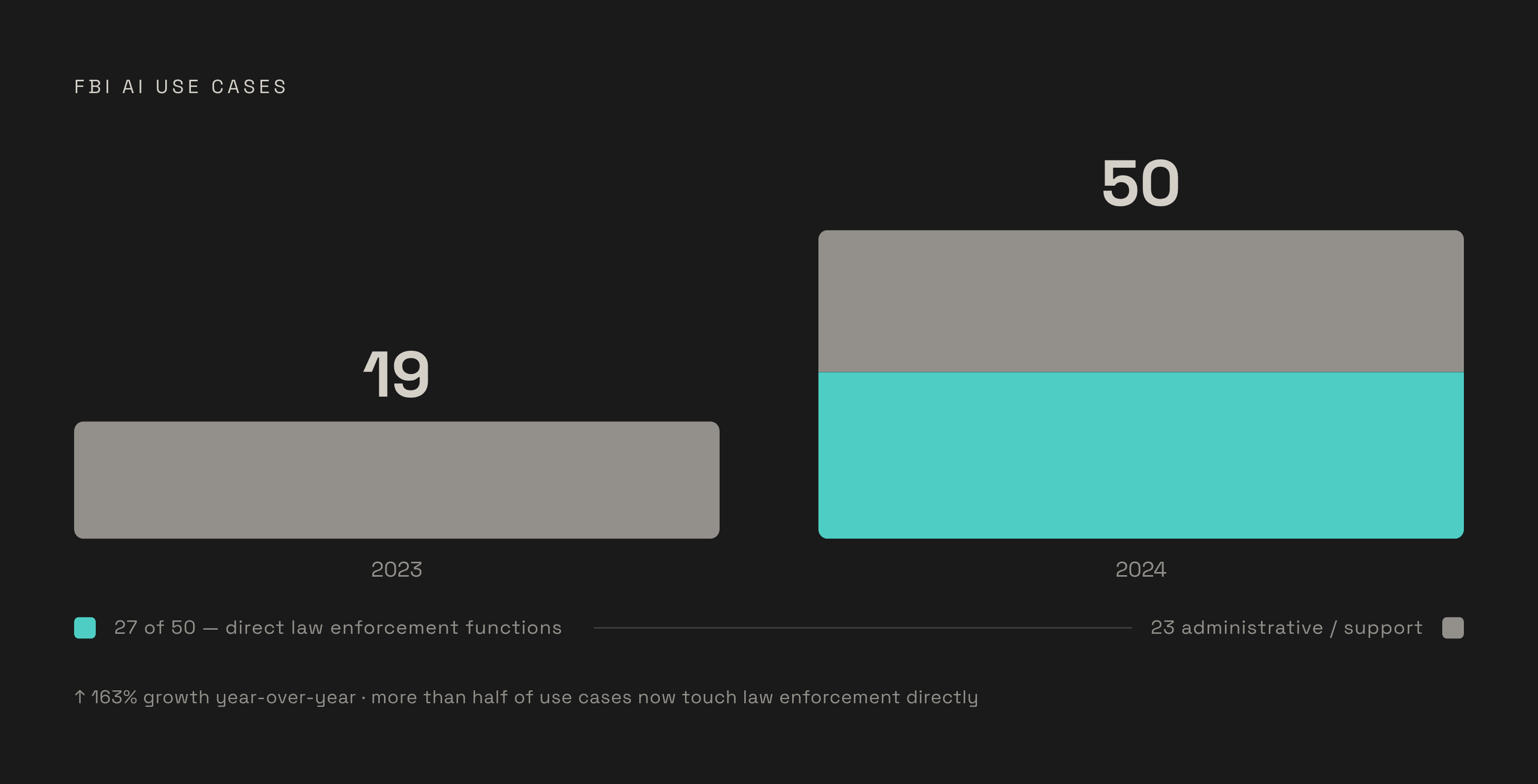
The FBI's share of that growth is its own story. The bureau went from 19 AI use cases to 50 in a single year, and 27 of those fall under what the DOJ's 2025 inventory classifies as law enforcement functions, not administrative or support work. That expansion did not start recently. The FBI traces its AI capability back to the 2013 Boston Marathon bombing, when investigators drowned in CCTV footage they had no good tools to process. The multimedia processing framework built out of that crisis eventually cut analysis time from nearly a year down to roughly two days. The tools came first, by over a decade in some cases, and the rules are still being written around them, since that kind of leap in operational power happened before almost every legal framework now trying to catch up to it.
The spread of these tools goes well past the FBI. The DOJ's Civil Division, the Bureau of Prisons, the ATF, the TSA, and NCIS all show up in the 2025 inventory, and each is using AI for something that touches someone's rights directly, whether that is immigration litigation, predicting who will reoffend, or tracking travel patterns. Looking across agencies in 2026, generative AI now shows up routinely in report writing, real-time crime centers pull together intelligence from multiple feeds at once, and drone-as-first-responder programs are running in the field. The tools have not just gotten more powerful one at a time. The whole set of them has gotten wider, which is the baseline fact the rest of this piece works from.
Why the official inventory understates what agencies are doing
The federal AI inventory is supposed to be the public's main window into how these systems work and how long agencies have been running them. In practice, it does the opposite more often than it informs.
Take the FBI's new facial recognition projects flagged in the 2025 inventory. None of the new facial biometric investigative-lead projects include any detail on how risks are being managed, and none of the high-impact use cases had finished the risk-management steps required of them as an April deadline approached. The inventory lists exactly three facial recognition instances with clear labels, and all three carry 2025 deployment dates, even though reporting shows the DOJ division involved has used the technology for years before that. That mismatch points to something specific: the inventory reflects what agencies chose to disclose, not when the technology actually went live.
Vendor sourcing compounds the problem. Most high-impact use cases that specify how the tool was acquired say it came from an outside vendor, but many of those vendor names are withheld or left blank, which makes independent testing close to impossible. A policy analyst told FedScoop it's "extremely difficult to get any kind of definitive sense in terms of how good it is, who's conducting the oversight or auditing or stress testing." Layered on top of that is officers using consumer AI tools on their own, without authorization, to draft reports. That use never appears in any inventory, and it is already shaping how cases get built and written up. Experts across the political spectrum, from the Cato Institute to the Center for Democracy and Technology to the Brookings Institution, describe the resulting disclosures as vague and incomplete, sometimes in ways that actively mislead. Citizens, defendants, and the legislators who are supposed to regulate all of this are left making judgments on information that experts who study this for a living say cannot be trusted to represent what's actually happening. That opacity matters most once the tools it hides start making decisions about who gets arrested.
Facial recognition's path from investigative aid to arrest trigger without independent evidence
The wrongful arrests tied to facial recognition do not read as a handful of bad days at a few departments. They read as a structural failure, where a probabilistic match generated by software gets treated by officers as probable cause on its own.
Kimberlee Williams, a grandmother in Oklahoma, was arrested on a Maryland warrant for a state she had never set foot in. Maryland police acted on an incorrect facial recognition result and did not tell the court they had relied on that technology when they applied for her arrest warrant. Williams spent six months in jail before the error surfaced. Her case is not a freak outcome. Most facial recognition algorithms are trained on datasets made up mostly of white faces, and the camera systems feeding them often fail to capture enough contrast for darker skin tones to register properly. The wrongful arrests documented in the research on this technology skew heavily toward Black suspects, which tracks directly with where the underlying models perform worst.
Detroit has already responded in a way that says something on its own. The city agreed to require officers to gather independent evidence on anyone identified through AI before they can seek an arrest warrant. Requiring that step forward only makes sense if the prior standard allowed officers to arrest someone on a facial recognition match alone. What links Williams's case to Detroit's new policy is automation bias: once a tool offers a name, the search for other evidence can stop there, often in direct violation of each department's own internal policy requiring that corroboration happen anyway.
How Veritone's Track tool is engineered to operate where facial recognition laws stop
Facial recognition is not the only way to track someone across a city's camera network, and that fact has become a selling point. As facial recognition drew tighter regulation, a market opened for tools that do the same surveillance work while sitting outside the legal definitions that trigger those rules.
Veritone's product, called Track, identifies people using body size, gender, hair color and style, clothing, and accessories. A large number of customers already run it, including state and local police departments and universities across the US, and US attorneys at the Department of Justice began using it for criminal investigations in August 2024. Veritone's CEO has been candid about why the product exists in the form it does: "The whole vision behind Track in the first place" was "if we're not allowed to track people's faces, how do we assist in trying to potentially identify criminals or malicious behavior or activity?" That sentence is about as direct a statement of intent as a surveillance product has offered. The restriction came first, and the product was built to work around it.
The ACLU calls Track the first nonbiometric tracking system it has seen used at scale in the US, and warns it raises every privacy concern facial recognition does while adding new ones of its own, including the detail that Track currently uses skin tone as a way to tell people apart even though it does not let users search by skin color directly. Veritone's own defense of the product rests on calling it a "culling tool," meant only to speed up review of video that already exists, not a general surveillance instrument, and the company's CEO has said he hopes it clears people as often as it points toward suspects. That framing runs into a basic problem: sorting through millions of hours of footage pulled from an entire city's camera network is, on its own, a new surveillance capability, whatever the stated intent behind building it. Whether that capability gets used carefully or not depends entirely on oversight that, as the previous two sections show, is not well equipped to catch it.
New Orleans turned covert illegal surveillance into a proposal to legalize it
New Orleans shows how far this trajectory can travel inside a single city. Its police department ran continuous facial recognition on a privately owned camera network in secret, kept at it after claiming to pause, and is now trying to become the first US city to make that kind of real-time surveillance of its own residents legal.
A 2022 city ordinance limited facial recognition to specific suspects in violent crimes and required quarterly reports to the chair of the City Council's Criminal Justice Committee. New Orleans police ran continuous facial recognition on a privately owned camera network for two years anyway, in apparent violation of that ordinance. When the department said it had paused its cooperation with the camera network, that pause did not hold. Emails show that as of November 2025, officers were still sending photos to the Project NOLA system to locate suspects, so the violation continued even after it had drawn scrutiny.
Instead of facing consequences for that, the city pushed an ordinance that would have made it the first in the country to formally authorize real-time facial recognition surveillance of residents. That measure has since been withdrawn, pending revisions, but the sequence stands on its own: a department broke its own city's law, got caught breaking it twice, and responded by trying to rewrite the law to match what it had already been doing. New Orleans is not an outlier in how this unfolds elsewhere. It compresses the general pattern: capability deployed without legal authority, a weak response once that was discovered, and an attempt to normalize the practice through legislation.
Predictive policing and data fusion extend surveillance beyond the moment of a crime
Everything covered so far involves identifying someone connected to a crime that has already happened. Predictive policing moves the surveillance earlier, often to people who have not been accused of anything, by treating historical enforcement patterns as a forecast.
One sheriff's office gives the clearest picture of what that produces. The sheriff's office there eventually admitted it had violated residents' constitutional rights, including the Fourth Amendment protection against unreasonable searches and the Fourteenth Amendment's due process guarantee, through a program that used predictive scoring to flag residents for repeated, unannounced checks. The program did not wait for evidence of a crime. It generated suspicion from patterns in the data and then sent officers out to act on that suspicion directly.
That same logic now runs inside federal agencies on a larger scale. The DOJ's 2025 inventory shows the Federal Bureau of Prisons using AI at multiple points to predict misconduct and recidivism, from intake classification and security assignment through a system called BRAVO Classification to ongoing recidivism scoring for current inmates and sex offenders. Researchers who study these models warn that they pick up on variables correlated with race and other protected traits and encode that bias into their outputs, even when the people building them explicitly try to prevent it. The ATF, separately, uses machine learning to flag travel data and identify routes or passenger movements it considers "atypical." A civil liberties analyst put the risk of that kind of system directly, saying it's "hard to think of something that would do more to encourage conformism and fear of breaching norms" than an opaque algorithm flagging ordinary travel as suspicious.
What makes this harder to contain than any single tool is fusion. A senior fellow at the Cato Institute told FedScoop that combining broad, loosely regulated investigative authority with AI tools and the databases agencies already have access to gives them "an amazing ability to put together very complete profiles on just about anybody in this country." A ban on facial recognition alone does nothing to stop that kind of profile from being built, since the underlying data, travel records, prison classification scores, flagged patterns, keeps flowing into the same systems regardless of what any one law restricts.
Why the current regulatory response has not closed the gap and may be widening it
Regulation written for one tool gets answered by a new tool built to sit just outside its definition. The disclosure process meant to catch that shift reports only what agencies choose to reveal. The DOJ's own inventory omits risk-management details for high-impact systems two years running. Vendor names go unlisted often enough that outside audit becomes close to impossible on the cases where it matters most. None of that is new behavior forced by some emergency. It is the ordinary operating mode of the current system.
One might argue that an inventory, however incomplete, still represents progress over no public accounting at all, and that is fair as far as it goes. But what if the inventory's main effect is to create a sense that oversight exists where the actual mechanics of accountability, independent audits, named vendors, risk-management sign-off, are still missing in the cases that carry the most weight? A Texas sheriff's office and Flock Safety both publicly described an 83,000-camera search across the country as a welfare check, while court records showed it was tied to a criminal investigation into a non-viable fetus. That single episode shows how a public claim about a surveillance tool's use can diverge from its actual use even after the fact, not just in the moment the tool is deployed.
The agencies driving adoption are not hiding that the technology works. The FBI's own account of cutting video analysis from a year to two days makes the case for these tools on its own terms. The argument running through every section here is narrower than a case against AI in policing. It is that the frameworks meant to govern facial recognition, nonbiometric tracking, predictive scoring, and data fusion are being outpaced by each one of those tools in turn, and the agencies using them have shown, in Detroit, in New Orleans, in Pasco County, that acknowledgment tends to arrive only after harm has already been done to a specific person. Whether the next round of oversight closes that gap or simply gets routed around again, the way Track was built to route around facial recognition law, is the open question the rest of this story is still being written to answer.
Sources
- States can—and should—regulate AI in criminal justice
- Artificial Intelligence and the Fourth Amendment: Two Emerging Legal Issues
- More than a Dozen Wrongful Arrests Due to Police Reliance on Facial Recognition Technology
- New Orleans Police Continuing to Use Live Face Recognition Despite City Law
- ACLU and ACLU of Louisiana Sound Alarm on New Orleans Police Department’s Secret Use of Real-Time Facial Recognition
- Fighting Pre-Crime?: Law Enforcement, Artificial Intelligence, and Predictive Policing Technology
- Artificial Intelligence in Predictive Policing Issue Brief