Financial Data Exposure in AI-Assisted Wealth and Tax Advice

Financial data exposure through AI tools happens through two separate channels that most users never distinguish: voluntarily typing sensitive figures into a chat window, and practitioners folding AI into client work without tracking what happens to the data afterward. Both channels move real tax and wealth information, Social Security numbers, account balances, trust structures, out of the systems built to protect them and into tools that were not.
How financial data moves from user to AI tool
Picture the moment itself: a taxpayer opens a chat window and uploads a W-2, or pastes the numbers from a 1099 to ask whether a deduction applies. That single act is the whole mechanism in miniature. The document leaves a system built around access controls, encryption standards, and retention rules, and it enters an interface that may have none of those by default. AI in tax and financial services used to sit in the back office, where it quietly sorted documents or flagged anomalies inside platforms built for that narrow purpose. It now sits in front of the user, answering questions directly. The sensitive data it needs to do that job travels with it at every step.
Two pathways account for most of this movement. The first is voluntary: people upload W-2s, 1099s, K-1s, estate tax documents, trust income records, or business files straight into AI platforms, or they skip the file entirely and just type the figures into a public interface. The second runs through practitioners, who bring AI into client work by reviewing documents, summarizing returns, spotting planning opportunities, drafting memoranda, or organizing financial records. A tax preparer who asks an AI tool to summarize a client's return is not thinking of that action as "uploading data," but the return's contents, income figures, dependents, filing status, all of it, has now left the firm's controlled environment.
Stripping a name off the data does not solve the problem. A practitioner who pastes client tax figures into a consumer chatbot while leaving out the client's name can still violate protected-information rules, because the combination of numbers and details, an income figure, a filing status, a state, a business type, can be enough on its own to point back to one specific person. Anonymization that only removes the label while leaving the shape of the data intact fails to anonymize anything.
Shadow AI adoption and compounded individual exposure
What happens when hundreds of employees across a firm make that same individual choice, each without the firm's knowledge? The industry has a name for it: shadow AI, meaning employees using AI tools without approval, security review, or compliance oversight. Once that becomes routine, the firm loses visibility into how client data moves, and a pattern of individual exposure turns into a blind spot across the whole organization. Shadow AI is distinct from a related but separate failure mode, agentic AI, where a tool is authorized for use but then acts on its own with too little supervision. The two problems look different on the surface, one is unauthorized use, the other is unsupervised authorized use, but they share the same root: nobody is watching closely enough to catch the gap before it matters.
Shadow AI breaks the chain of custody that compliance and supervisory frameworks assume exists. Those frameworks are built around the idea that a firm can trace a recommendation back to the data behind it: what information was used, where it came from, where it went afterward, and what controls applied along the way. When an employee runs client data through a personal AI account that compliance never approved, that trace disappears, and the firm cannot reconstruct it after the fact even if it wants to.
Consider one way this plays out mechanically. A client updates their investment objectives in a CRM system that is not integrated with the firm's compliance platform. An AI tool then draws on the older, unsynced data and generates a supervisory report based on objectives the client no longer holds. The firm may not be able to show the examiner that a recommendation matched the client's current objectives, since the systems never talked to each other. That gap sits quietly until an examination forces it into view, at which point it is no longer a technical oversight but a supervisory failure.
What breach records from 2025–2026 show about where the losses concentrate
How much of this is a live risk? The record from 2025 and 2026 answers that question with specific, dated incidents, and the pattern they share is that a single point of failure can cascade across thousands of client relationships almost instantly.
At KerberRose Wealth Management, an unauthorized third party got into a single employee's email account on April 29, 2026. From that one account, the exposure spread to tens of thousands of clients, with data including full names, addresses, Social Security numbers, bank and financial account details, and dates of birth all compromised together. That particular combination of data points is what makes the incident serious: any one of those fields alone is a nuisance, but names, Social Security numbers, account details, and birth dates together give a criminal nearly everything needed to open credit or drain an account.
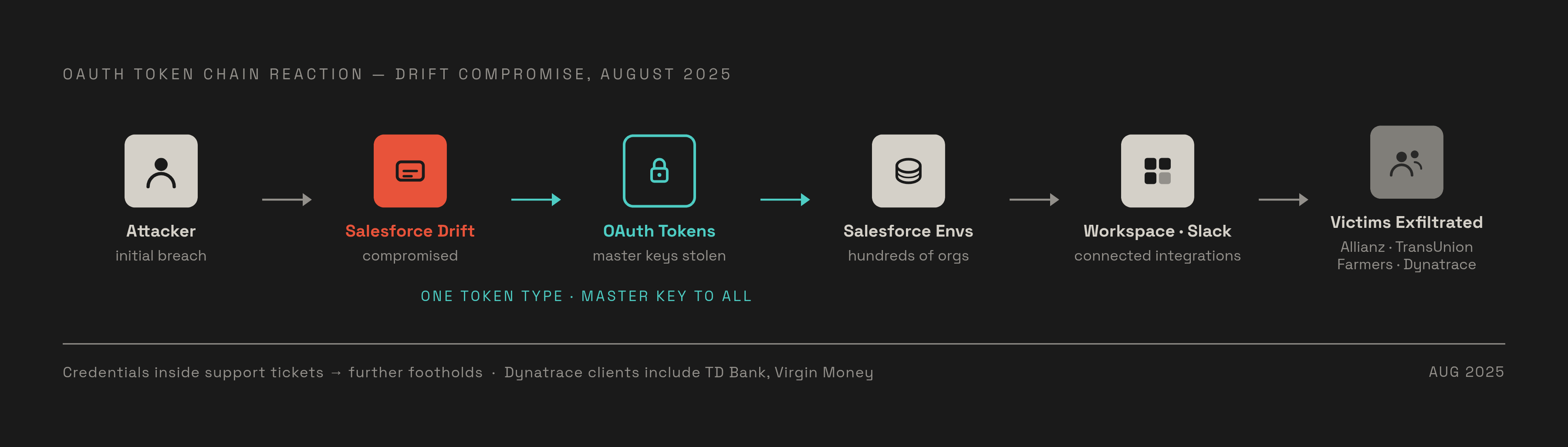
The Salesforce Drift incident in August 2025 shows a different pathway into the same kind of loss, the third-party integration. Attackers compromised Drift, an AI chatbot owned by Salesloft and wired into Salesforce installations across thousands of organizations. Rather than breaking into each organization one at a time, the attackers stole OAuth tokens that Drift used to authenticate into customer Salesforce environments, and in some cases into connected Google Workspace and Slack integrations as well. Those stolen tokens opened the door to hundreds of organizations simultaneously, pulling out contact records, account data, support cases, and sales pipelines from companies including Allianz Life, TransUnion, and Farmers Insurance, along with Dynatrace, whose own client list includes TD Bank and Virgin Money. Credentials sitting inside support tickets gave attackers a further foothold into systems beyond the initial breach. One compromised chatbot integration, in other words, became a master key for an entire category of connected software.
A third kind of case shows what happens once this sort of data, or a close enough fake of it, reaches the hands of someone willing to use it for fraud. In 2024, a finance worker at a Hong Kong multinational authorized a very large transfer after what looked, by every visible signal, like a legitimate video conference call with colleagues. Every participant on that call was a deepfake. The incident makes a point that breach statistics alone do not: once AI-sourced financial data about a person and their advisor relationships exists somewhere accessible, it becomes raw material for building a convincing impersonation, not just a record that might someday leak.
The advice quality failure that runs alongside the privacy failure
Exposure on the way in is only half the problem. What comes back out, the advice itself, carries its own risk, and that risk runs independently of whatever happens to the input data. A user who hands over sensitive financial information to get a personalized answer is exposed twice: once through the data leaving their control, and again through an answer that sounds confident regardless of whether it holds up.
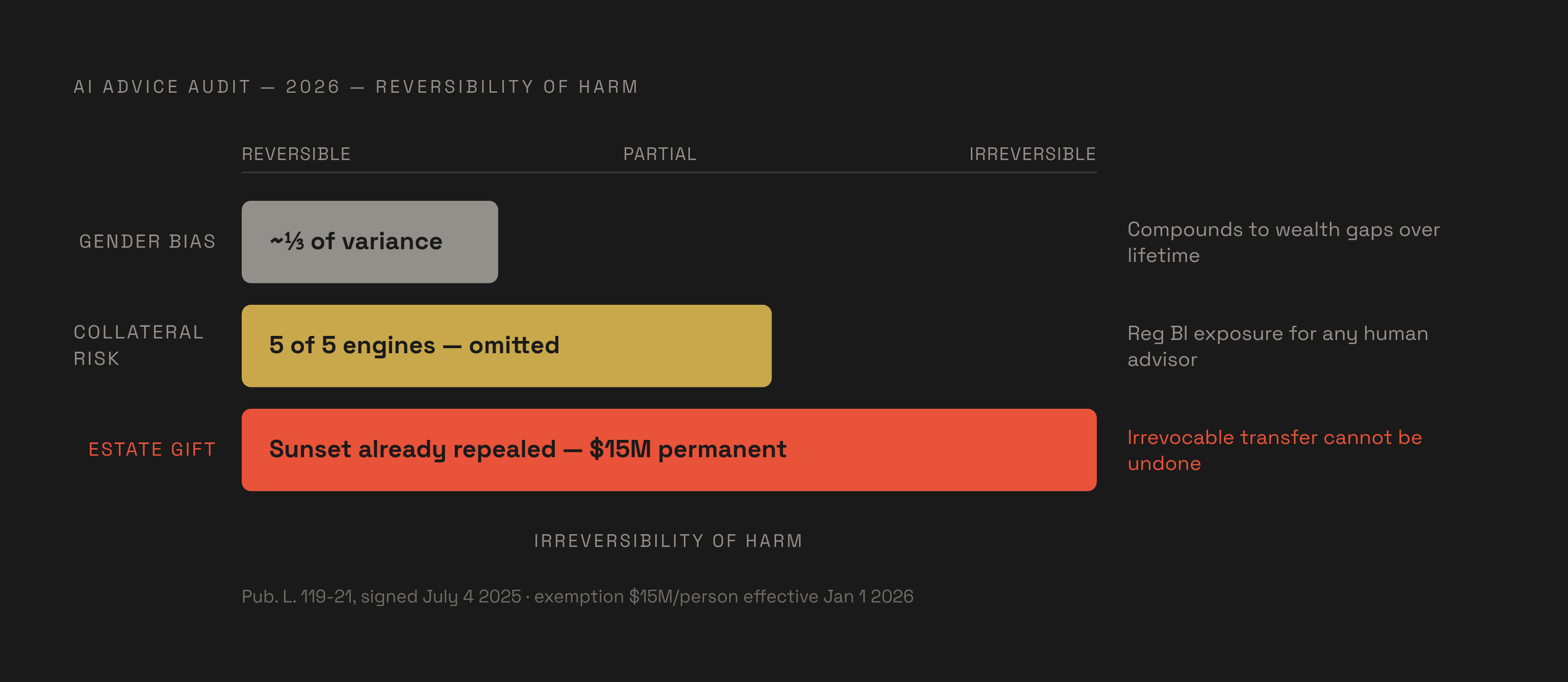
A 2026 audit of five major AI engines on questions relevant to ultra-high-net-worth wealth planning found that all five understated the risks of premium financing strategies. Collateral call risk, the single most consequential downside scenario in that kind of arrangement, was regularly left out of the answer entirely, making it the risk most often missing across all five engines. If a registered representative gave a client that same incomplete answer, they would face exposure under Regulation Best Interest. The AI tool that generated the answer faces nothing of the kind, because no regulatory framework currently holds it to that standard.
Estate tax advice failed in a different way, one that is more permanent. Engines tested in the same 2026 audit were still telling clients to make irrevocable gifts to lock in a higher estate tax exemption before a sunset date, treating the advice as urgent under a "use it or lose it" framing. That sunset had already been repealed. The One Big Beautiful Bill Act, signed July 4, 2025 (Pub. L. 119-21), permanently raised the federal estate, gift, and generation-skipping transfer tax exemption to $15 million per person, effective January 1, 2026. An irrevocable transfer made on the strength of outdated advice cannot be undone once it happens, which makes this category of error categorically worse than a wrong answer to a question with no lasting consequence.
Research applied a representative sample of prompts to GPT-5.2 and found that the advice these systems return varies systematically by gender. About one-third of that variation comes from the model itself supplying different recommendations to otherwise identical prompts once a gender label is attached. The remaining two-thirds comes from men and women writing different prompts in the first place, independent of what they were actually asking about. The researchers found that over a full life cycle of saving and investing decisions, these gaps compound into real differences in accumulated wealth.
None of this is a detour from the privacy argument. It strengthens it. Users share sensitive financial data specifically to get an answer tailored to their situation, and the exchange they are making, more exposure for better advice, is not actually delivering the better advice half of that bargain. Confidence in the output gives no signal about whether it is right.
IRS OPR Alert 2026-19 and updated SEC requirements
As of mid-2026, any practitioner still treating AI use in tax and financial work as a regulatory gray zone is working from an outdated assumption. Two separate frameworks, one from a tax regulator and one from a securities regulator, now impose specific obligations on how AI touches client data, with civil and criminal consequences attached to both.
Regulatory guidance addressed to tax professionals addresses the practitioner side directly: tax professionals who input client data into AI tools without adequate safeguards, or without verifying how a vendor handles and retains that data, can face consequences for mishandling protected taxpayer information, regardless of whether the practitioner intended any harm. Updated SEC rules push in a parallel direction from the advisory side, holding firms responsible for demonstrating that AI-assisted recommendations are backed by current, accurate client data, and for showing that appropriate supervisory controls applied to how AI tools were used in forming those recommendations.
What remains genuinely open is where the line sits between a practitioner's internal, exploratory use of AI, think of a preparer brainstorming general strategies with anonymized hypotheticals, and the use of actual client data in a workflow that touches a real return or a real recommendation. That distinction matters because it is the one practitioners will have to make for themselves in the field, often in real time, without the benefit of a bright-line rule from the regulator. Firms and individual practitioners can no longer treat the absence of a specific prohibition as permission. The frameworks now in place assume firms are actively managing this risk, not waiting for an enforcement action to find out whether they were.
Enterprise-grade AI deployments versus consumer tools
One might argue that the entire problem traced through the sections above is really about the gap between what enterprise-grade deployments do and what the consumer tools most people actually reach for do not. Closing that gap means understanding what separates the two.
Enterprise deployments, the kind large asset managers and wealth platforms build for internal use, typically run on closed data pipelines. Contracts with the AI vendor spell out that the vendor cannot use client data to train its models. Data residency controls specify where information is stored and under what jurisdiction. Audit logging tracks every query and every output, so after the fact you can reconstruct what data fed into what recommendation. None of this comes standard with a consumer or prosumer AI product. A retail chatbot interface and an enterprise deployment can run on comparable underlying technology while differing completely in what surrounds that technology: the contracts, the logging, the residency guarantees, the audit trail.
That raises an important question: if the fix is institutional, does it do anything for the individual practitioner or taxpayer who has no institution behind them? The strongest case against this piece's whole argument says govern the channel rather than the technology itself: build the contracts and the logging and the residency controls, and the exposure mostly resolves. That case holds up as institutional advice. It falls apart for the solo tax preparer, the independent advisor, or the individual taxpayer doing their own planning, because that person is not inside an enterprise deployment and never will be on their own. Their actual choice sits between a consumer AI tool with none of those protections and no AI assistance. Telling them to wait for better institutional architecture answers a question they were not asking.
Architectural and behavioral safeguards that reduce exposure for practitioners and individual users
Closing the gap described in the last section takes two different kinds of action, and neither one substitutes for the other. Architectural choices determine which tools are even safe to use with financial data. Behavioral disciplines determine how carefully those tools get used once chosen. Good habits applied to the wrong tool still leave data exposed, so the order matters: pick the architecture first.
On the architectural side, a few questions settle most of the decision. Does the tool retain prompts, log inputs, or use submitted data to train its underlying model? Consumer AI products typically do one or more of these things as a matter of course, while tools built for privacy or enterprise use typically prohibit it by contract. Does the tool offer explicit data residency controls, contractual limits on training use, and audit logging, the same features that separate enterprise deployments from the ordinary consumer interface? Practitioners specifically should check whether a given AI vendor counts as a "service provider" under Reg S-P, and whether the firm's contract with that vendor includes a 72-hour breach notification obligation. Tools built around the principle that user data is never retained or used for training keep the data with the user instead of handing it to the provider by default, offering a structural answer for anyone who needs AI capability without an enterprise's infrastructure behind them.
On the behavioral side, a short list of disciplines holds regardless of which tool gets chosen. Identifiable client documents, W-2s, 1099s, K-1s, estate records, should never go into a consumer AI interface; anonymized or aggregated figures can serve the same exploratory purpose without the same exposure. Any AI output addressing a complex financial question, multi-state income, Roth conversions, premium financing, estate exemptions, deserves treatment as a draft that needs professional review before anyone acts on it, not a finished answer. The 2026 audit cited earlier found all five major engines mishandling exactly these kinds of UHNW questions in ways that would expose a human advisor to regulatory consequences. The SEC is already examining firms for supervision failures tied to AI-assisted advice, so practitioners should document every instance of AI-assisted client work and keep records showing that recommendations rested on current client objectives.
Architecture sets the ceiling on how much exposure is possible. Behavior determines how close to that ceiling any individual user or firm actually operates. Both matter, and neither one, on its own, closes the gap this piece has traced from the first uploaded document to the regulatory frameworks now watching for the mistakes that follow.
Sources
- AI Financial Advice: Supply, Demand, and Life Cycle Implications
- Evaluating AI for Finance: Is AI Credible at Assessing Investment Risk?
- From Frontier to Shadow AI: A Simmering Threat to Assurance and Security in Critical Infrastructure
- June 24, 2026
- IRS Issues Its Introductory Guidelines on Responsible AI Use
- AI Compliance for Firms and RIAs in 2026
- Financial Data Security and AI: Can You Trust the Tools with Your Numbers?
- AI Regulation in Financial Services: Turning Principles into Practice