AI Tools for Journalists Covering Sensitive Sources
Consumer AI systems retain source information indefinitely, creating permanent liability.
Most journalists now use AI as part of daily reporting work: Muck Rack's State of Journalism 2026 report puts the figure at 82%. This piece is about what happens in the gap between that adoption curve and the much slower, much less developed thinking around protecting sources when AI enters the workflow. The tools reporters reach for first, ChatGPT and a fast-growing Google Gemini, are consumer-grade products built for general productivity rather than confidentiality. That's a reasonable choice for drafting a newsletter or summarizing a public filing. It becomes a different kind of choice when the material involved is a whistleblower's name, an off-the-record conversation, or any detail that could get a source fired, deported, or worse.
None of this calls for journalists to retreat from AI. The tools genuinely help with pattern recognition across large datasets, with summarization, with transcription, the kind of grinding reporting work that used to eat entire afternoons. The argument here is that the industry has adopted AI faster than it has built judgment about when and how to use it, and that gap is starting to show. Concerns among journalists about unchecked AI use inside their own newsrooms grew sharply through 2026, rising to a level comparable to broader public-trust anxieties about AI in society. The profession, in other words, has started to notice what it's doing. What's missing is a concrete framework for doing it differently, one that matches the tool to the task rather than treating all AI use as equally safe or equally risky.
Data Retention Architecture, Not Brand, Makes AI Dangerous for Source Protection
The single most important fact to understand about AI risk in source-sensitive reporting has nothing to do with which company built the tool or how impressive its outputs look. It has to do with what happens to data after it's entered. Once sensitive content goes into a cloud AI system, a journalist cannot reliably get it back out: there is little an average user can do to remove data from an AI model once that data has been learned, according to the Freedom of the Press Foundation's guidance on using AI safely. These systems are built this way as a structural fact, not a policy choice any single company can easily reverse.
This differs from a conventional data breach in a way that matters for reporters specifically. A retained prompt or chat history doesn't need to be stolen in a dramatic hack to become a liability. It can sit quietly inside a company's systems, exposed by accident or extracted later by a sophisticated adversary, without the journalist who entered it ever learning that it happened. The practical rule that follows is blunt: identifying information about a source who needs to remain private indefinitely, or any off-the-record conversation, should stay out of publicly accessible generative AI models entirely, regardless of how capable or trustworthy the provider seems. Trust in a brand is not a security control. Retention architecture is the thing to evaluate, and it's worth asking of any tool: where does this data go, and who, under what legal process, can compel it to be produced? Most journalists currently treat "be careful with AI" as a vague mood rather than an operational instruction. The rest of this piece works toward a decision rule that replaces the mood with a tiered structure tied to task type and the actual stakes of exposure.
How Specific Platforms Create Distinct Liability Profiles
Retention architecture doesn't look the same across platforms, and the differences are concrete enough to act on. OpenAI's ChatGPT offers a Temporary Chat mode that creates a session with no lasting paper trail, a real structural improvement over its standard mode, though it does nothing to protect content if the session itself is intercepted before it ends. That's a meaningful option for Tier 1 work, discussed in the framework below, but it isn't a universal fix.
Google Gemini's retention policy has more moving parts. Chats are held for 72 hours for service operations when a feature called Keep Activity is turned off, but any chat flagged for safety review is retained for up to three years. For a reporter working a whistleblower story, that three-year window is a fixed period during which content remains accessible to the platform and potentially reachable through legal process. It's a long time for a single flagged conversation to sit somewhere outside the journalist's control.
DeepSeek sits in a different category, shaped by geopolitics rather than purely technical factors. The Freedom of the Press Foundation notes that its privacy policy states that data is stored on servers in the People's Republic of China and may be shared to meet legal obligations or satisfy "public interest" as defined under Chinese law, a standard with no equivalent in Western press-shield protections. The adversary implied by that policy is a state actor operating inside a legal system that explicitly places public-interest determinations above individual privacy. Weighing that risk means thinking less like a security analyst and more like a foreign correspondent assessing which government might want to know who a source is.
Two threat vectors that operate outside the journalist's own AI use
Commercial spyware, built with AI and once confined mostly to intelligence agencies, has become widely available to governments and other actors who want to target reporters. The Committee to Protect Journalists has noted that the mass surveillance infrastructure built for online advertising has, as a side effect, supercharged the tools available for surveilling journalists.
The CPJ report on Morocco, following an Amnesty International investigation, documents what that looks like in practice. Journalist Omar Radi, previously a target of Pegasus spyware, reportedly had his apartment bugged with hidden microphones. Hicham Mansouri told Amnesty International that years of sustained surveillance pushed him toward self-censorship. Information that appears to have come from surveillance was leaked to pro-government media outlets to fuel smear campaigns against the journalists targeted. None of that depended on which chatbot either journalist used for research.
The second outside threat is less dramatic but more likely to appear in an ordinary reporter's week: the AI notetaker. The Freedom of the Press Foundation's 2026 digital security checklist for journalists flags AI notetakers in online meetings as something newsrooms should have a policy about, covering both when they're permitted and what to do if one appears uninvited. The checklist doesn't treat this as a headline threat category, but it should register as one for anyone handling sensitive calls. A journalist might make every correct decision about their own AI use and still end up with a source's words transcribed and stored by a third-party notetaker that joined the call from the source's end. The reporter may never know it happened. That blindspot sits entirely outside the tiered framework that governs the journalist's own tool choices. It has to be addressed separately, through meeting policy rather than tool selection.
A practical framework for matching tool choice to the confidentiality stakes of each task
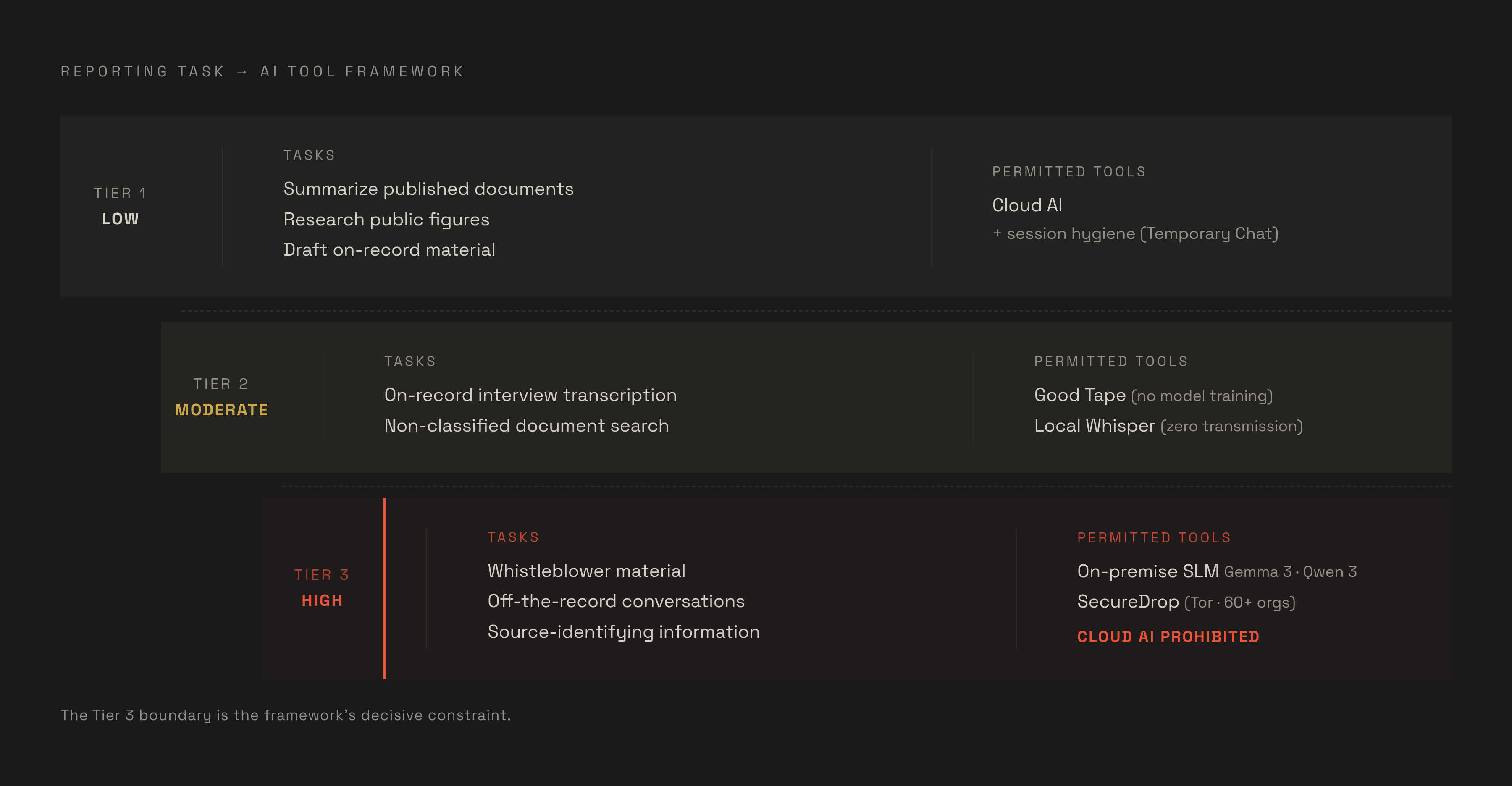
The question to ask before using AI on any piece of reporting material is what would happen if this specific content were retained somewhere and later exposed. The answer to that question determines which tier of tool is appropriate, and three tiers emerge from the available guidance.
Tier 1 covers public-interest tasks with no source-identifying content: summarizing documents that are already published, researching background on public figures, drafting from material that's already on the record. Standard cloud AI tools, used with reasonable session hygiene such as Temporary Chat mode where it's offered, are acceptable for this tier.
Tier 2 covers source-adjacent tasks where identifying details could appear by accident: transcribing on-record interviews, searching through document collections that aren't classified or sensitive. Purpose-built, privacy-first tools belong here. Good Tape, a transcription tool built by journalists with security as a design priority, doesn't use customer transcription files to train its models in any way. Whisper, OpenAI's transcription model, run locally rather than through the cloud, is the only option among these that never transmits audio to a third-party server, which makes it suitable for confidential source interviews.
Tier 3 covers anything involving source-identifying information, whistleblower material, or off-the-record conversations. AI should not touch this content in cloud form under any circumstance. Two options exist here. Small language models run on-premise are one: a paper by Hagar, Diakopoulos, and Gilbert presented at the Computation + Journalism Symposium 2025 found that quantized models including Gemma 3, Qwen 3, and GPT-OSS run effectively on ordinary desktop hardware with 24 GB of memory, producing high citation validity and making local deployment realistic even for newsrooms without large technical budgets. SecureDrop, built by the Freedom of the Press Foundation, is the other: an open-source platform that news organizations install on their own servers, using the Tor network for anonymity and strong encryption, already in use at more than 60 media organizations worldwide, with its journalist-facing app rewritten from the ground up and released feature-complete following a security audit in early 2026.
The same tier logic applies to AI used for source monitoring, the ongoing work of watching government pages, regulatory filings, and corporate investor disclosures for changes. That monitoring work is usually Tier 1, since the pages themselves are public. What matters more is how alerts get routed: sending them to a shared desk address rather than a named reporter's personal inbox cuts down the trail connecting a specific alert to a specific source relationship. The point of the tier system isn't to push every task toward maximum caution. Most reporting work doesn't need Tier 3 treatment, and forcing it there wastes time and local compute for no security benefit. The risk runs the other direction too: treating Tier 3 material as though it were Tier 1 is the mistake that actually exposes sources.
Local Deployment Is Not a Complete Solution
Running models locally might seem like it solves the problem. It solves the privacy dimension, but not the reliability dimension, and the two are not the same thing. The Hagar, Diakopoulos, and Gilbert 2025 paper that validated local small language models for newsroom use also found real variation in reliability across different models, documented error propagation through multi-stage synthesis tasks, and performance that swings substantially depending on how much a model's training data overlaps with the actual corpus being analyzed. None of that goes away because the model is running on a desktop instead of in the cloud.
There's a practical hardware ceiling too. Long document-QA sessions on local machines can hit memory limits fairly fast as the model's working memory, the KV cache, grows with the conversation. That forces journalists to scope their questions and sessions carefully rather than treating a local model as an unlimited research assistant.
Reliability problems aren't unique to local deployment either. Research from NYU Journalism and MuckRock, cited in Visualping's guide to AI tools for journalists, found that while large language models produce short summaries of meeting transcripts quickly and accurately, their long summaries include only around half the relevant facts. That failure occurs regardless of whether the model runs on a laptop in a newsroom or on a server somewhere else. One might ask: if the model is wrong in roughly the same way everywhere, what actually protects the reporter? Human judgment applied consistently, not the location of the hardware, is what answers that.
A study of Norwegian newsrooms covering the 2025 parliamentary election complicates that answer. Researchers identified what might be called a catch-22: newsrooms that lean heavily on AI risk losing exactly the human expertise needed to catch AI's errors and spot when its outputs are shaping coverage in ways nobody intended. The oversight mechanism depends on a kind of expertise that heavy AI use tends to erode over time. The framework has to include explicit human review built into every tier, not bolted on afterward. For document search, that means citation chains linking every AI-generated claim back to a specific source document, the same design the Hagar system requires structurally rather than as an optional feature. For transcription, it means checking the output against the original recording before quoting a word of it, a step that isn't optional no matter how reliable the transcription tool claims to be.
Applying the framework: what changes for a journalist starting a source-sensitive investigation today
Put into practice, this framework changes three specific decisions at the outset of any investigation involving a sensitive source: what gets entered into AI at all, which tier of tool handles it, and what the newsroom's policy says about uninvited AI in meetings.
The first decision happens before a single word gets pasted into any tool. Before entering content into AI, a reporter needs to ask whether it contains anything identifying a source, anything said off the record, or anything whose exposure could cause harm that can't be undone. If the answer is yes, the material belongs in Tier 3, or outside AI entirely. If the answer is no, the next question is whether identifying details might still slip in incidentally, which points to Tier 2, or whether the material is genuinely public-facing throughout, which points to Tier 1.
Misclassification happens most often at the second decision point. Interviews involving a confidential source fall into Tier 3 automatically, and yet the habit for most reporters is to reach for whatever cloud transcription tool is already open on their laptop. The appropriate tools are locally-run Whisper or Good Tape, and the choice between them depends on whether cloud processing with a no-training guarantee (Good Tape) or zero transmission of audio (local Whisper) better fits the threat model. A reporter weighing a source who fears a foreign intelligence service might lean toward the option that never sends data anywhere. A reporter more worried about a domestic legal subpoena might weigh the tradeoff differently.
The third decision needs to happen before the first sensitive call, not after something goes wrong on one. The Freedom of the Press Foundation's 2026 checklist recommends that newsrooms decide in advance when AI notetakers are permitted in meetings and have a plan ready for what to do if one joins uninvited. This is a policy question for the newsroom to settle collectively.
One durable question runs beneath all three decisions, and it's the question that should outlast any specific tool mentioned here as products change and new ones launch. Privacy-preserving AI architecture, meaning systems built from the start so that data simply cannot leave the journalist's control, lines up structurally with what Tier 3 work demands. The test for any AI tool a journalist considers for sensitive work is whether the system is built so that retaining or exposing that data is structurally impossible in the first place.
Sources
- 3 writers weigh in on AI and journalism in 2026
- On-Premise AI for the Newsroom: Evaluating Small Language Models for Investigative Document Search
- Best AI Tools for Journalists in 2026: Organized by Task
- State of Journalism 2026 Report Shows Rising AI Use, Growing Concerns Over Disinformation and Funding
- The GenAI Catch-22: Use of Generative Artificial Intelligence in Norwegian Newsrooms During the 2025 Parliamentary Election
- Using AI safely as a journalist: Stand-alone AI tools
- How mass surveillance from online advertising puts journalists at risk - Committee to Protect Journalists