The Economics of Training Data and Why User Conversations Are Valuable
User conversations beat licensed publisher data because they're fresh, authentic, and self-labeled.
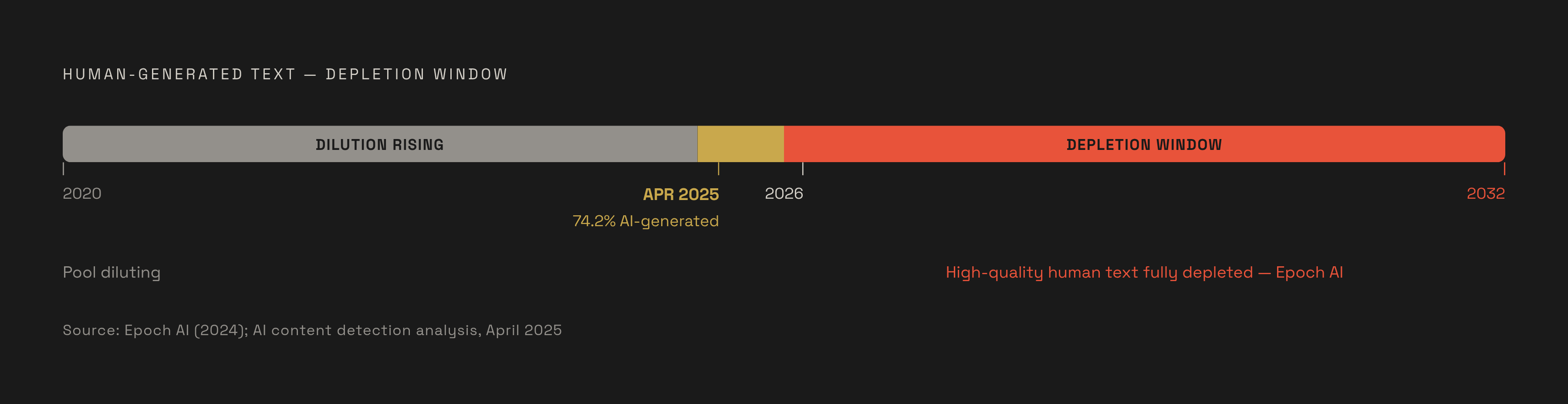
The constraint on building better AI models used to be compute and architecture. It has shifted to data quality and availability. The open web, the corpus that trained GPT-series models, Llama, and DeepSeek, has effectively run dry as a source of fresh, high-quality human writing. Epoch AI's research, cited across a wave of 2025 and 2026 analyses, puts a window on the problem: high-quality human-generated text could be depleted somewhere between 2026 and 2032, depending on how aggressively labs train against it.
What does "depleted" actually mean for a resource that lives on billions of web pages? "Depleted" means the stock of text written by a human being, for a human audience, without AI involvement in its drafting, stops growing fast enough to keep pace with what frontier labs need to push capability forward, not that the internet runs out of words. And the pool that remains is being diluted in real time. By April 2025, 74.2% of newly created webpages contained some AI-generated text, a figure that underlies multiple analyses from that year. That means the next scrape of the web, the one meant to feed the next generation of models, increasingly captures the outputs of the last generation of models rather than original human thought.
This feedback loop has a formal name in machine learning research: model collapse. A 2025 Apple study gave the phenomenon a concrete, measurable edge, finding that large reasoning models suffer complete accuracy collapse on complex tasks when they are trained recursively on synthetic data, meaning data generated by prior models rather than people. If synthetic data could simply substitute for human text at scale, the depletion timeline would not matter much. Labs could generate their way past it.
That is what makes this constraint structural rather than cyclical. A cyclical shortage gets solved with more investment: build more data centers, hire more annotators, buy more compute. A structural shortage cannot be solved by spending more, because what is scarce is human-generated activity, not something a factory or a data center can produce on demand. It is a byproduct of unprompted human activity, the comments, questions, and arguments people were always going to produce anyway.
How a market for training data formed almost overnight
Scarcity produces prices, and the AI training data market went from marginal to material in a short span. The market barely existed in a formal sense three years ago. It is now expanding rapidly enough to draw serious institutional attention: Grand View Research values the global market at $3.2 billion in 2025, with growth projected to more than quadruple that figure by 2033 at a rapid compound annual rate. Quartz's analysis states the shift without much room for interpretation: the era of free AI training data is over, and what has replaced it comes with a price list.
The scale of the biggest disclosed deals shows what that price list looks like at the high end. OpenAI's five-year licensing agreement with News Corp runs into the hundreds of millions of dollars. Reddit's content licensing deal with Google, struck to help train Gemini models, pays out tens of millions of dollars annually. Reddit's own IPO prospectus disclosed a portfolio of data licensing arrangements with an aggregate contract value in the hundreds of millions. These are recurring, contractually binding revenue lines rather than pilot programs or experimental partnerships. They are recurring, contractually binding revenue lines, treated by the companies that hold the underlying content as a business unit in their own right.
The same scarcity that created this market is also closing off the option of simply taking the data for free. AI training crawlers surged year-over-year in April 2025, but growth slowed sharply by July as more publishers implemented bot-blocking. The open web is actively closing rather than sitting static, waiting to be mined. It is actively closing, one blocked crawler and one licensing negotiation at a time. That closure raises the question of which data commands the highest price, and why.
Live user conversations are more valuable than licensed publisher content
Licensed publisher archives, no matter how large the check that pays for them, share a common limitation. They were written for an audience of readers, polished, edited, and shaped by an author who knew the words would be read. Live user conversations carry a different character entirely, and that difference is what makes them the most sought-after category of training data now on the market.
The first property is authenticity. A comment posted in frustration about a delayed product shipment, a reply typed quickly in a support thread, a review written the moment a customer felt cheated or delighted: these are unrehearsed. They capture how people actually think and phrase things in the moment, not how they perform for an audience, which is closer to what a blog post or a polished article represents. The second property is that conversations refresh continuously. A licensed archive of news articles is fixed the day the contract is signed. A live conversational stream generates new material every day, at scale, and it shifts as language, culture, and context shift along with it, something no static archive can do no matter how it is updated by its publisher.
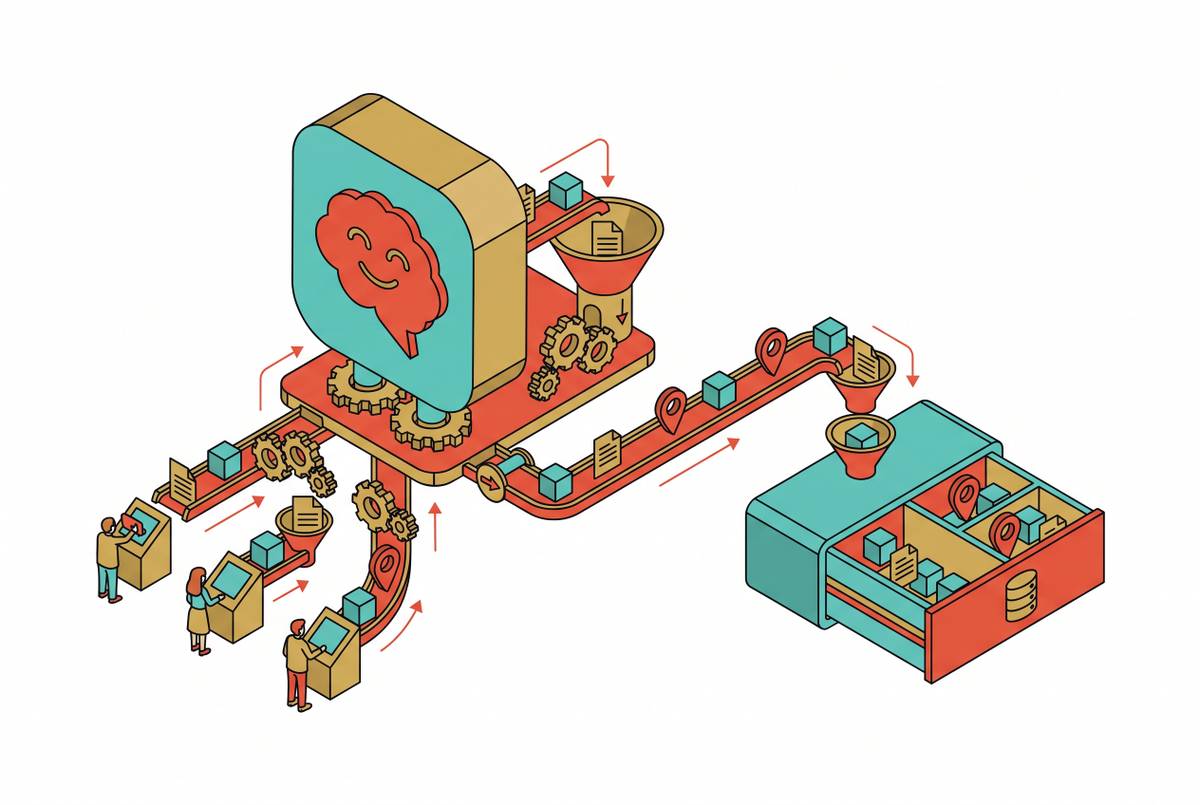
The third property is the one licensed text cannot replicate under any circumstance: implicit behavioral labeling. When a user continues a conversation, rephrases a question because the first answer missed the point, or abandons a thread entirely, that sequence of actions signals something about the quality of the response the AI gave. A published article carries no such signal. It sits on the page whether or not it satisfied anyone. A conversation carries a built-in verdict, rendered by the person who needed the answer, in real time.
Meta's position in this market shows what this advantage looks like at maximum scale. Mark Zuckerberg has said Meta's corpus of hundreds of billions of publicly shared images and tens of billions of public videos on Facebook and Instagram exceeds the size of Common Crawl, one of the largest open web scrapes used across the industry to train foundation models, and he has described that proprietary social data as a core part of what differentiates Meta's Llama models. ChatGPT reached 700 million users as of August 2025, making live-product conversations the largest continuously generated corpus of authentic, diverse human language now available to any single company, orders of magnitude larger than any single licensed publisher deal. One might argue that publisher deals still matter because they provide dependable, legally clean, well-structured text. That's true as far as it goes. But structure and cleanliness are not what current frontier models are short on. What they are short on is the unstructured, reactive, evaluative signal that only a live user produces.
The second reason conversations matter: they teach AI how to behave, not just what to say
Conversational data fills a training corpus and drives alignment, the process of turning a raw language model that can predict text into a product that behaves the way people actually want it to. Reinforcement Learning from Human Feedback, known as RLHF, sits at the center of that process. Its central benefit is that it lets a model approximate a goal that is difficult to specify exactly in code or instructions, something closer to "be helpful and honest" than "return the correct numeric answer". Essentially every aligned chat model shipping in mid-2026 relies on RLHF or one of its direct successors as its post-training step. It is the industry standard approach, not an experimental one.
User feedback data is what feeds that loop. It captures how people rate responses, what they find helpful or irritating, and where a conversation succeeds or collapses, and that record guides ongoing improvements and flags where a model needs further training. That means a single conversation does two jobs simultaneously. It trains the model on language patterns, the raw statistical relationships between words and concepts, and at the same time it trains the model on what a satisfying interaction actually looks like from the other side of the screen.
Why does that distinction matter to a general reader chatting with an AI product? Because it reframes what a conversation is, from the model's perspective. It is a judgment, rendered by a person, about whether the system did its job well. A licensed news archive cannot supply that judgment at any price, because nobody was grading the output of a news article against a user's expectation in the moment it was read.
Whether AI-generated feedback could eventually replace users in the alignment loop
The strongest challenge to everything argued above comes from inside the alignment research itself. Reinforcement Learning from AI Feedback, or RLAIF, substitutes a model's own judgments for human ones in parts of the training loop, and the evidence for it is not weak. Human evaluators strongly prefer both RLAIF and RLHF over supervised fine-tuning alone, and in head-to-head comparisons, RLAIF is rated equally to RLHF. For harmless dialogue generation specifically, RLAIF has outperformed RLHF in evaluator preference. If a model's own feedback can match or beat human feedback on some tasks, does the economic case for paying to harvest user conversations start to look shakier?
It's a fair question, and the honest answer requires a concession before it requires a rebuttal. RLAIF's competitive performance in these studies is conditioned on the models producing that AI feedback having themselves been aligned using human feedback in the first place. Strip that human-authentic anchor away and run the loop again, AI feedback trained on AI feedback trained on AI feedback; the trajectory bends back toward the same collapse dynamic documented in the recursive-training research discussed earlier. RLAIF works because it stands on a human foundation that it does not replace.
A second, quieter objection runs in the opposite direction and deserves equal weight. RLHF itself faces real limitations in how fully it can capture human values, and researchers have raised questions about how well it scales as models grow larger and more capable. Conversations remain economically valuable precisely because no synthetic substitute has been shown to work in isolation from them, even as researchers keep testing and refining that boundary.
What AI companies do with user conversations by default
Given everything above, how are the companies building these products actually treating the conversations flowing through them? Using consumer conversations to train models is the default arrangement across the industry's leading products, not an exception carved out by any one company. Stanford researcher Jennifer King, a Privacy and Data Policy Fellow at Stanford HAI, studied the privacy policies of six major US AI companies, Amazon, Anthropic, Google, Meta, Microsoft, and OpenAI, and found all six employ users' chat data by default to train their models.
The specific policies show how deliberately this default has been structured. OpenAI's privacy policy as of June 2026 permits using consumer content to train models unless the user opts out; the business tiers, Enterprise and Team, run the opposite default, not used for training unless the user opts in. That asymmetry between what happens to a free consumer's data and what happens to a paying business customer's data is itself a signal about which data OpenAI considers most commercially sensitive to protect and which it considers valuable enough to retain by default. OpenAI's enterprise privacy documentation states that it draws on data from ChatGPT users and human trainers, alongside public sources, licensed third-party data, and other individual-facing services, to make its outputs safer and more accurate.
Anthropic updated its consumer terms in August 2025 so that new or resumed chats and coding sessions can be used for model training by default, while commercial products like Claude for Work and its API remain outside that change. Meta's advantage runs through a different mechanism entirely: its structural position rests on the proprietary corpus of Facebook and Instagram posts that Zuckerberg has already positioned as exceeding Common Crawl in scale, giving its Llama models differentiated training material without the need to negotiate third-party licensing deals at all. None of this reflects a hidden agenda. It reflects a rational response to the economics laid out in the sections above: conversational data is the scarcest, most behaviorally rich input available, and companies structure their defaults to capture as much of it as their user base will permit.
The value gap: who profits from the data and who generates it
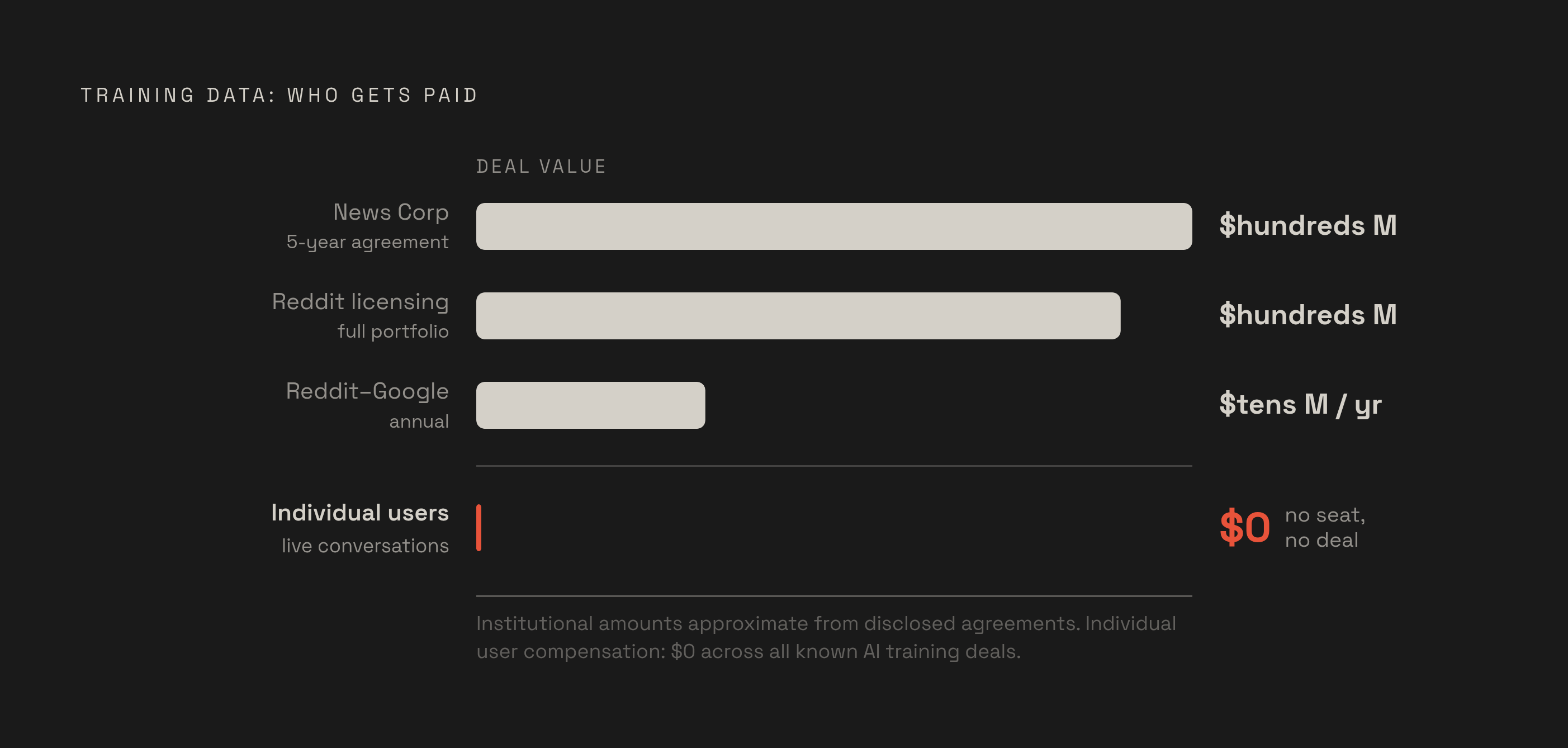
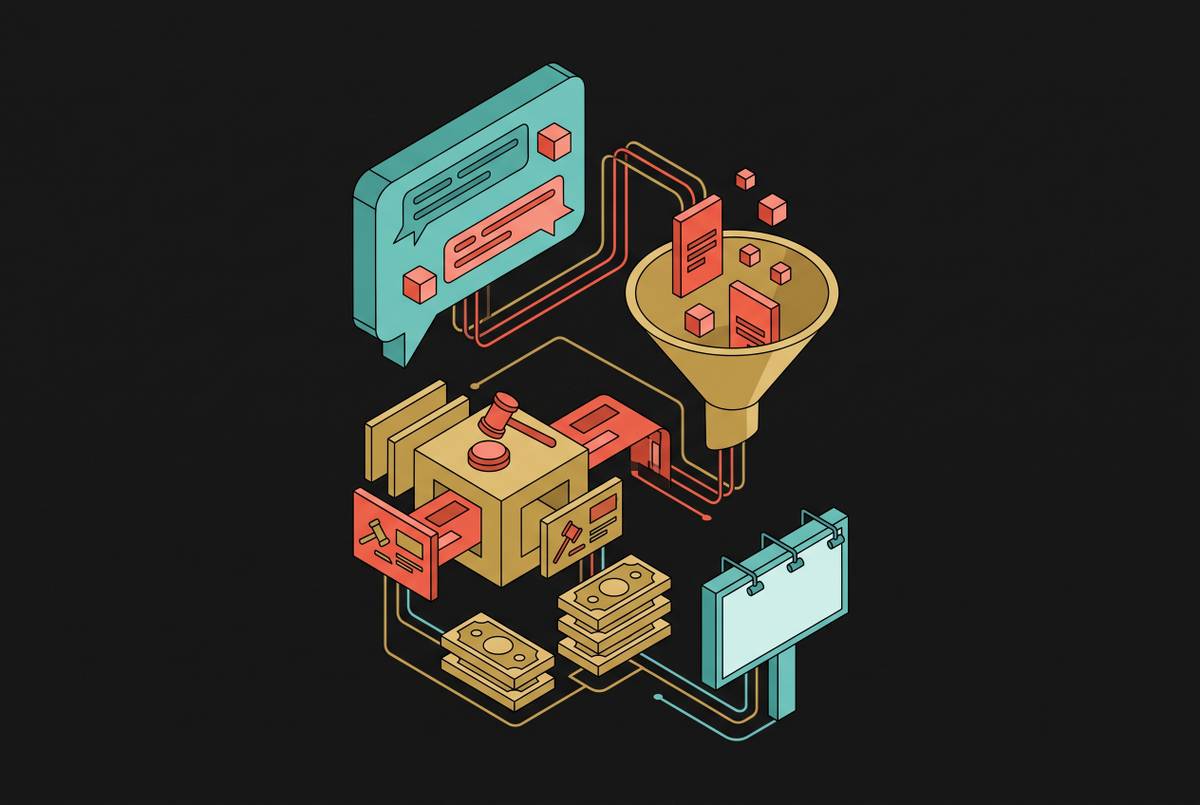
Here is where the asymmetry running through this entire piece becomes concrete. The market for training data has generated returns that flow almost entirely to institutional sellers and to the AI companies buying from them, not to the individuals whose everyday conversations form the most continuously valuable input of all. Publisher deals prove that organizations with structured, negotiable content can extract real value from AI companies: News Corp's five-year agreement, Reddit's annual licensing arrangement, Shutterstock's licensing business, all stand as evidence that a seller with legal standing and a bargaining position gets paid.
A single user typing into a chat window has no equivalent seat at that table. No contract gets negotiated over an individual's conversation history, and no per-message royalty arrives. That is the position an individual occupies in this market, generating, conversation by conversation, the raw material that a licensed publisher's archive cannot fully replace, without any of the leverage that a publisher's legal and business apparatus provides.
The consumer-versus-enterprise default split described in the previous section makes this asymmetry visible in product terms. An enterprise customer pays for a tier of service where a data-usage opt-out is built into the contract from the start. A consumer user has to go find the opt-out in a settings menu, and most never do. Geography adds a further layer of fragmentation. Regulatory pressure, rather than individual choice, is the mechanism currently doing the most to shift these defaults, and it is doing so unevenly across jurisdictions rather than as a matter of company policy applied uniformly worldwide. The user who happens to sit inside a stronger regulatory regime ends up with more protection than the user who does not, even when both are typing into the identical product.
The privacy risks that attach specifically to conversations used as training data
The properties that make a conversation valuable as training data, its specificity, its personal context, its behavioral signal, are the same properties that expose a user to risk once that conversation enters a training pipeline. A conversation with an AI product can include sensitive information by its nature: financial details mentioned in passing, health concerns described in detail, personal disputes worked through in real time. When that content becomes training data, it could potentially be exposed or leaked, and the resulting models become vulnerable to security and privacy attacks, with particular exposure in domains like finance and healthcare where the underlying information carries lasting consequences if it surfaces again.
This concern is the direct cost side of the value already described. A publisher's licensed archive carries essentially no privacy risk of this kind, because nobody disclosed a medical condition to a newspaper column. A user conversation carries that risk by definition, because the entire reason the conversation is valuable is that it captures something specific, personal, and real about the person who typed it. The same quality that makes conversational data irreplaceable as a training input, its rawness, its immediacy, its behavioral honesty, is what makes it the category of data most capable of harming the person who produced it if handled carelessly. Understanding that trade-off, rather than being told to feel any particular way about it, is what lets a user weigh what they are actually handing over each time they open a chat window.
Sources
- The price of AI training data, from $5M to $250M - Quartz
- AI Training Dataset Market Size & Share Report, 2026-2033
- Why Social Data Is Becoming the Most Valuable AI Training Asset
- Ask ChatGPT: Caveats and Mitigations for Individual Users of AI Chatbots
- The Economics of AI Training Data: A Research Agenda
- You Pay $20/Month. ChatGPT Still Trains on You.
- OpenAI (ChatGPT) Privacy Policy Review 2026
- Enterprise privacy at OpenAI