Why Free AI Products Are Structurally Incentivized to Harvest Data
The infrastructure costs of AI demand a revenue source, and user data is the asset already in hand.
Free AI products are not free. A working paper from a national statistics agency. Bureau of Economic Analysis, authored by Samuels, Soloveichik, and Nakamura, makes this concrete by treating free digital content as a barter transaction: the user hands over something of value, and access to the product is what comes back in exchange. That "something" is data, attention, or both.
The BEA's own estimate gives a sense of scale AI Training Data Runs Out 2026 - INZIU. In 2025, users generated $407 billion worth of content, while for-profit firms produced $1,489 billion worth of free content for those same users to consume AI Training Data Runs Out 2026 - INZIU. Something has to subsidize what users contribute beyond what companies give away, and that subsidy has to come from somewhere in the business model AI Training Data Runs Out 2026 - INZIU.
Shoshana Zuboff's concept of surveillance capitalism offers a useful lens for understanding what fills that gap, though it belongs here as a framework rather than as the article's conclusion. Older data-driven business models mostly recorded transactions: what someone bought, when, for how much. The surveillance capitalism model, as Zuboff describes it, goes further. It captures behavioral tendencies, patterns of intent and hesitation and preference, and sells access to predictions about what a person will do next. That's a different kind of asset, and it changes what "free" is actually paying for.
None of this requires assuming bad faith. The purpose of this piece is to trace why data collection functions as a structural feature of the free-AI business model rather than a lapse in judgment or an ethical shortcut, because the incentive runs in a straight line from infrastructure cost to revenue design to data policy. Getting that chain in front of the reader, piece by piece, is the point of everything that follows.
Why running AI at scale is expensive enough to require a revenue offset
Start with the size of the industry doing the spending. The AI-as-a-service market is projected to grow from $20.26 billion in 2026 to $91.20 billion by 2030, a compound annual growth rate of 35.1% The price of AI training data, from $5M to $250M - Quartz High Peak Software. Growth at that pace does not happen on cheap infrastructure. It happens because the underlying cost of building and running these systems is large enough to justify, and require, that kind of capital inflow.
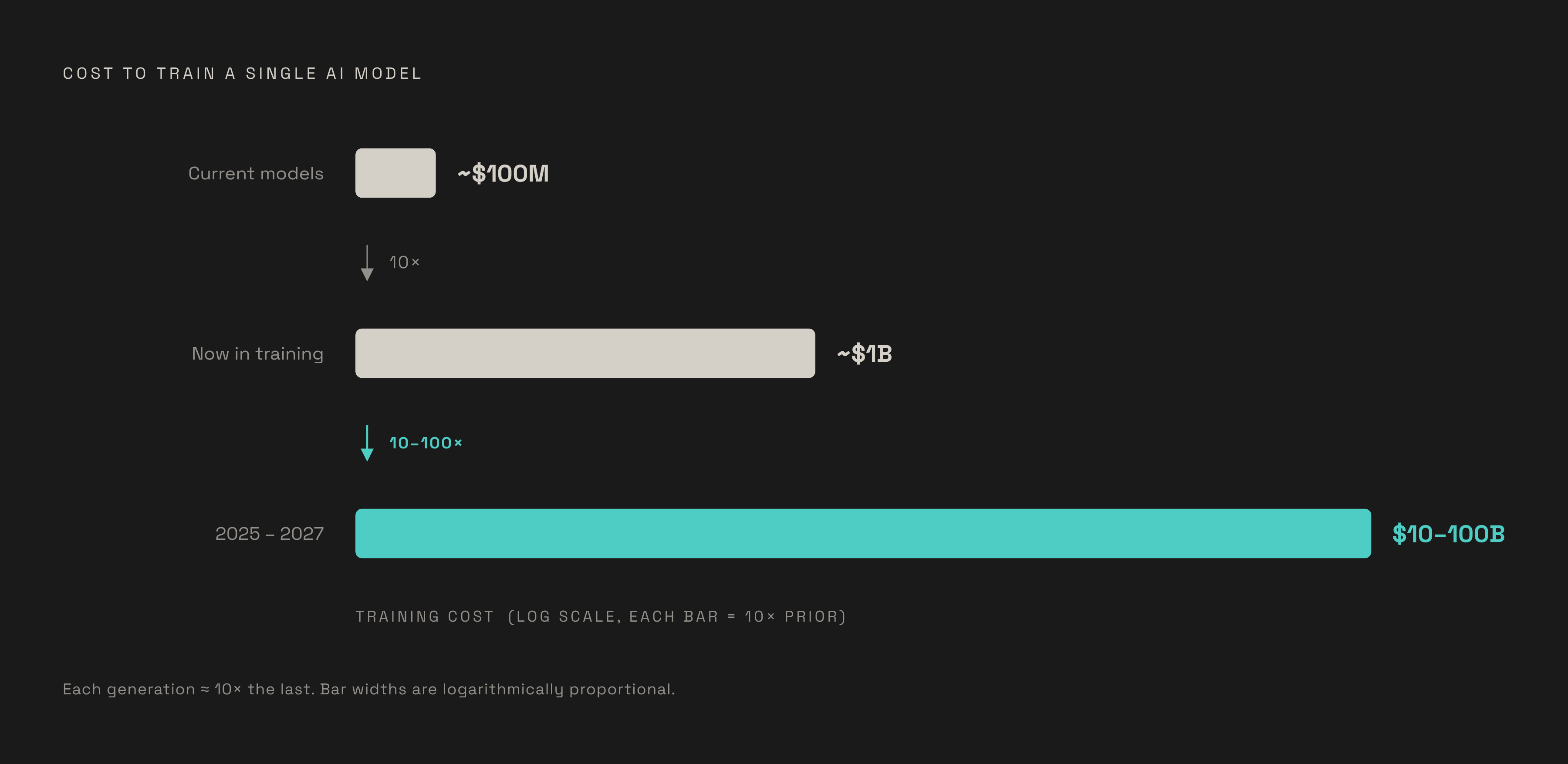
Training costs alone illustrate the escalation. Current-generation models run around $100 million to train AI Training Data Runs Out 2026 - INZIU. Models now in training are estimated at roughly $1 billion AI Training Data Runs Out 2026 - INZIU. Model training costs have escalated sharply: current models cost around $100 million to train, models now in training cost roughly $1 billion, and expected models between 2025 and 2027 could reach $10 to $100 billion AI Training Data Runs Out 2026 - INZIU. That is not a linear climb, it's closer to an order-of-magnitude jump every generation, and each jump has to be paid for by someone before a single free user ever types a prompt.
Training is only half the ledger. Inference, the actual work of answering a query once a model exists, adds a second and continuous cost layer, since every free user who runs a query burns compute the company has to fund in real time rather than once. Data cleaning, human labeling, and licensing agreements pile on top of that as ongoing costs tied directly to how good the model stays over time, not one-off expenses that get paid down and forgotten.
Putting those pieces together makes the conclusion hard to avoid. Nobody has to have planned this in a boardroom for it to become the default path of least resistance. It's simply the asset that's already there. The structural consequence is that a company offering free access to a $100M–$1B product must find a revenue source proportionate to that cost, and the user's data is the asset already in hand AI Training Data Runs Out 2026 - INZIU.
Why training data has become scarce and expensive, making user interactions a cost-avoidance strategy
What happens to a data-hungry industry when the free data runs out? Epoch AI, a research group that tracks the constraints on how far AI scaling can go, projects with 80% confidence that the stock of publicly available human-generated text will be fully used up somewhere between 2026 and 2032 The price of AI training data, from $5M to $250M - Quartz. That's not a distant, theoretical horizon. It's inside the planning window of any company building a frontier model right now.
The scale of the problem becomes clearer with a single figure. The indexed web holds around 500 trillion words of unique text, which sounds close to infinite until it's measured against how fast frontier models consume it The price of AI training data, from $5M to $250M - Quartz. Consumption is outpacing production. The internet is not making new high-quality human writing anywhere near as fast as the largest models can absorb it, and that mismatch is what turns "training data" from a resource into a market with a price list.
And it is, genuinely, a market now. The global AI training dataset market was valued at $3.59 billion in 2025 and is projected to reach $4.44 billion in 2026 according to Fortune Business Insights, while a separate estimate from MarketIntelo puts the dataset licensing segment at $4.8 billion in 2025, growing to $22.6 billion by 2034. Specific deals put real numbers on what licensing costs in practice. Amazon's first AI-focused licensing deal with the New York Times, according to reporting from the Wall Street Journal, runs $20 million to $25 million per year AI Data Privacy Compared: Every Provider (2026).
Set those numbers next to the cost of a free user typing into a chat window. One costs tens of millions of dollars a year, negotiated through lawyers and contracts. The other costs nothing, and it's already flowing in continuously. That asymmetry is what makes user-generated conversation such an efficient substitute for expensive licensing: every exchange a free user has with a chatbot is data a company did not have to buy.
The pattern appears concretely in coding tools. Developer Mario Zechner, creator of the open-source harness Pi, told TechCrunch that Claude Code, by default on consumer accounts, stored coding agent sessions and fed them into reinforcement learning training, and Zechner attributed the visible jump in coding-agent capability between April and October 2025 to that exact practice. That's not a hypothetical mechanism. It's a named developer, a named tool, and a specific window of improvement traced back to a default data-collection setting. Given the scarcity laid out above, that default reads less like an aggressive choice and more like the obvious one.
How the free-vs-paid privacy split is structured across the major platforms in 2026
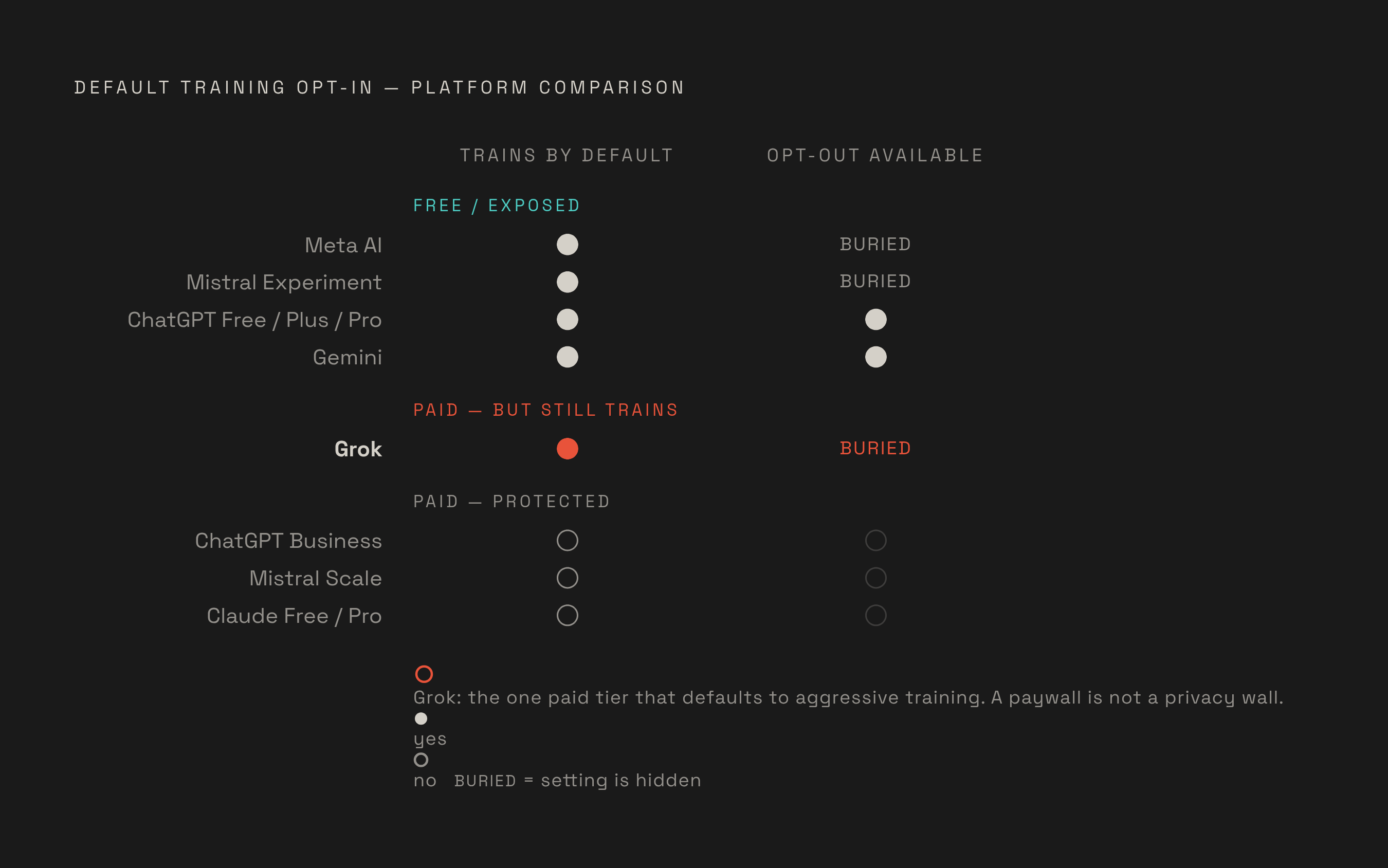
Once training data becomes scarce enough to price, and free interactions become valuable enough to substitute for licensing, a predictable pattern appears across the industry. Consumer free tiers default to training on user data, with the opt-out, where one exists, buried somewhere in account settings. Business, enterprise, and API tiers, by contrast, tend to exclude data from training by default. That split is consistent enough across platforms in 2026 to treat as a rule, though it comes with at least one important exception before anyone assumes paying always solves the problem AI Training Data Runs Out 2026 - INZIU.
OpenAI's ChatGPT, across its Free, Plus, and Pro tiers, uses conversations to train future models by default. The opt-out sits under Settings, then Data Controls, then a toggle labeled "Improve the model for everyone," and it has to be switched off manually. Conversations that happened before that toggle gets flipped may already be sitting inside training data. ChatGPT Business, priced at $20 per user per month billed annually or $25 per month billed monthly, does not use conversations for training by default AI Data Privacy Compared: Every Provider (2026). Same company, same underlying model, opposite default, depending entirely on which tier is paying the bill.
Google's Gemini follows a similar split. Gemini's Apps Privacy Hub adds that human reviewers look at conversations and that data can be retained for up to three years.
Mistral's free Experiment tier opts users into training by default, with a manual opt-out tucked into an admin Privacy menu. Its paid tiers split further still: pay-as-you-go customers can opt out but are not opted out automatically, while Scale plan customers are opted out by default.
Now the exception. Grok, from xAI and X, is available only to paying Premium and Premium+ subscribers, yet it still defaults to aggressive training that includes scraping X posts. Paying for Grok does not buy the same default protection that paying for ChatGPT Business does AI Data Privacy Compared: Every Provider (2026). That single case breaks the assumption that a paywall automatically equals a privacy wall, a point to remember every time "just pay for the subscription" gets offered as a fix. Meta AI, meanwhile, is free, trained on by default, and offers no opt-out at all for US users, though a formal, if obstructive, opt-out process exists in EEA and UK markets.
A 2026 review of AI privacy defaults from merciv.com found the same shape repeating across vendors: free or individual paid tiers default users into training with an opt-out toggle buried three menus deep, while an enterprise agreement with that same vendor flips the default and adds contractual language on top of it. Worth noting, too, that users inside the EEA, Switzerland, and the UK often receive paid-tier data protection terms even on nominally free services, which means the privacy split described here is partly a product decision and partly something regulation is enforcing on the company's behalf. For Claude.ai (Free/Pro), Anthropic states free tier conversations may be used for training, manual opt-out is required, and data may be held for up to 5 years without opt-out AI Data Privacy 2026: The AI Privacy Trap - drainpipe.io.
This pattern isn't staying confined to companies that were built around AI from day one. Atlassian announced default AI training data collection across Jira, Confluence, and its other cloud products, effective August 17, 2026. The policy touches more than 300,000 customers globally Atlassian AI Training Data Default: Opt-Out by Tier (2026) | byteiota.
Free and Standard tier customers cannot opt out of metadata collection at all.
Why does this case matter more than one more entry on a list of platforms? Because Atlassian was never marketed as an AI company. Its customers signed up for project management and documentation software, not a data-training relationship, and the two-tier privacy model appeared inside that product anyway. That's the real significance here: as AI features get embedded into existing software categories, the harvest-on-free-tier logic migrates with them, and users who never signed up for "an AI product" are now inside this model.
Courtney C. Radsch, writing in Project Syndicate on July 20, 2026, frames this migration as part of a broader policy failure. Radsch argues that governments have allowed business models built on the commercial exploitation of personal data to spread largely unchecked, and that the AI industry is now replicating that same model at a larger scale. That argument sits at the edge of this piece rather than at its center, but the Atlassian rollout is exactly the kind of quiet, contractual expansion Radsch is describing. De-identified, aggregated metadata is retained for up to 7 years to train AI features including Rovo AI, Rovo Chat, Rovo Dev, and automated agents, with in-app data removed within 30 days of opt-out Atlassian AI Training Data Default: Opt-Out by Tier (2026) | byteiota.
Why behavioral data from AI interactions raises the stakes
Everything covered so far explains why companies want data. This section is about why AI interaction data specifically is worth so much more than the data these same companies were already collecting.
Browsing history reveals what a person clicked on. Purchase records reveal what a person bought. A conversation with an AI system reveals something closer to how a person thinks: their intent, their reasoning process, their emotional state in the moment, the actual shape of a decision as it's being made. That's a qualitatively different kind of record, richer and far more predictive than anything a cookie or a loyalty card ever captured.
Notice, too, how many "convenience" features are actually data-collection mechanisms wearing a friendlier face. Image uploads, voice mode recordings, persistent memory that carries context across sessions, personality customization that learns a user's preferences over time, all of these build a comprehensive behavioral profile as a byproduct of making the product feel more helpful. Mobile apps extend that surface even further into the physical world: 45% of AI chatbot apps collect location data, according to Surfshark's 2024 research. AI companion apps push this furthest of all, commodifying emotional connection itself and drawing on intimate conversations that are both unusually sensitive and largely unregulated.
Where does all this end up? The data broker ecosystem, an industry valued at roughly $315 billion in 2026, exists specifically to receive and amplify it, converting behavioral records into products sold onward to advertisers, insurers, employers, and governments. This is the mechanism Zuboff's framework, introduced earlier, was pointing toward: not simple data storage, but predicted-behavior-as-product. The point here isn't to sound an alarm. The data moving through these systems isn't abstract metadata sitting in a server somewhere, it's a granular behavioral record, and its commercial value explains why the incentive to collect it runs as deep as it does.
What honest alternative business models require
Not every business model needs this trade-off, and some clearly don't. Freemium structures funded by subscription revenue are the clearest example: a paying user base covers the cost of the free tier, and the company earns from subscriptions rather than from data monetization, which measurably reduces the structural pressure to harvest and sell what free users produce.
Enterprise cross-subsidization works on a related principle. The free individual tier functions as a marketing channel that funnels users toward paid enterprise contracts, and individual users end up benefiting from a product whose actual funding comes from corporate customers rather than from their own data.
Open-source and locally run models go a step further still. No data ever leaves the user's own machine, which means the privacy guarantee is architectural rather than promised. That distinction matters more than it might first appear. A policy is something a company chooses to follow and can just as easily choose to change in the next terms-of-service update. An architecture that never collects the data in the first place removes the choice entirely, because there's nothing sitting on a server waiting to be repurposed.
That difference, between privacy added as a policy layer and privacy built into the system so collection becomes structurally impossible, is the one that actually predicts long-term behavior. It maps directly onto whether a company has any financial reason to collect data in the first place. Research on free versus paid apps generally finds that free apps collect, on average, three more categories of data than their paid counterparts, and that gap tracks the business model, not the product category or the developer's intentions.
What follows from all this is a fairly practical takeaway. Judging an AI tool's privacy posture is not, primarily, a matter of reading its privacy policy line by line. It's a matter of understanding what the company's revenue model actually requires it to do with user data, because that underlying requirement will outlast any specific policy statement written to describe it. Privacy-preserving tools built on architecture designed from the outset to keep data out of the provider's hands represent a credible response to that requirement, addressing the structural problem directly rather than papering over it with another settings toggle.
How to read any free AI product's privacy posture using the business model as the primary signal
Before opening a privacy policy at all, it helps to ask a simpler question first: where does this company's revenue actually come from? If a free user contributes nothing to that revenue through subscriptions or transactions, then that user's data is very often the only thing of value they're producing for the business, and everything else in the policy tends to follow from that fact.
A short set of questions makes this concrete when evaluating any specific product. Where does the company's money come from: advertising, subscriptions, enterprise contracts, data licensing, or some combination? What is the default setting for training data use, opt-in or opt-out, and how many steps does reversing that default actually take? Does upgrading to a paid tier change that default, or does the platform, like Grok, keep training on paid-user data regardless of what's being paid? Are there contractual no-training terms in writing, or only a policy statement the company could revise unilaterally next quarter? And, finally, is the privacy guarantee architectural, so the data genuinely cannot be collected, or merely a promise of restraint layered on top of a system that could collect it at any time?
A handful of concrete red flags show up across almost every platform surveyed here: an opt-out buried three menus deep, vague "business partners" language sitting in a privacy policy with no further detail, no opt-out mechanism offered at all, and data retention that continues for years regardless of whether a user opts out for conversations that already happened.
None of this is really an argument for outrage. It's an argument for pattern recognition. Data harvesting inside free AI products is not a policy failure waiting on better regulation to fix it automatically, it's the predictable output of a cost structure that requires user data as a substitute for revenue it doesn't otherwise have. Regulation, where it appears, tends to follow the economics rather than override them, as the EEA and UK carve-outs described earlier make clear. Understanding that chain, from training cost, to data scarcity, to tiered defaults, to the value of behavioral data itself, is what turns any single privacy decision into something durable rather than a one-time settings change that quietly reverts the next time the product updates. The choice of which tools to trust does exist. It just requires knowing, concretely, what to look for in the policy language.
Sources
- SCB, Estimating the Impact of “Free” AI Services on Growth and Productivity, June 2026
- Top AI Business Models Transforming Industries | High Peak Software
- AI Will Supercharge Surveillance Capitalism by Courtney C. Radsch - Project Syndicate
- The price of AI training data, from $5M to $250M - Quartz
- AI Data Privacy Compared: Every Provider (2026)
- AI Data Privacy 2026: The AI Privacy Trap - drainpipe.io
- Atlassian AI Training Data Default: Opt-Out by Tier (2026) | byteiota