Voice AI Data Collection in Consumer Devices
Billions of voice devices collect biometric data most users never consented to share.

Voice AI has moved from novelty to infrastructure, and the devices doing the listening capture far more than the words spoken to them. What they gather includes biometric signatures, emotional cues, and behavioral patterns most people never agreed to share, and understanding that full picture, from the moment audio hits a microphone to the moment it might turn up in a breach report, is the baseline for making an informed choice about the hardware sitting in a kitchen or a car. Voice AI Data Collection in Consumer Devices
The privacy implications of voice device scale
Scale is the first thing worth grasping, because the numbers involved are no longer niche. Estimates put active voice assistants worldwide at 8.4 billion, a figure that surpasses the global population itself, with more than 10 billion queries processed daily across phones, smart speakers, cars, and wearables Voice Search Statistics 2026 Juniper Research. In the United States specifically, the user base is projected to reach 157.1 million people by the end of 2026, up from 153.5 million the year before, and that growth is broad rather than concentrated in any single age group or income bracket Voice Assistant Statistics 2026.
Money is following the same curve. The voice recognition market was valued at $18.39 billion in 2025 and is projected to climb to $61.71 billion by 2031, a 22.38% compound annual growth rate Voice AI in 2026 Voice Search Statistics 2026. That kind of investment doesn't slow down collection, it accelerates it: more devices shipped, more queries logged, more audio flowing somewhere for processing.
What does a figure like 8.4 billion actually mean for privacy, though Voice Search Statistics 2026 Juniper Research? It means that even a small percentage of mishandled data represents exposure for tens of millions of people, because the base is so large that fractions of a percent still land in the millions. This is the environment most consumers are already living inside, regardless of whether they've thought about it in these terms.
What your voice transmits beyond words
The common assumption is straightforward: a voice assistant hears words, turns them into text, and that's the end of it. That assumption is incomplete.
An acoustic signal carries a lot more than the sentence spoken into it. Start with biometric identity. A voiceprint, shaped by vocal cord length, throat and nasal cavity geometry, and habitual speech patterns, is about as unique as a fingerprint. Unlike a password, though, it can't be reset once it's been exposed.
Then there's emotional state. Machine learning models trained on pitch variation, speaking rate, pause length, vocal tremor, and the ratio of harmonic to noise content in a voice signal can infer mood with a fair degree of reliability, whether the speaker intends to reveal anything or not.
Health information rides along too. Research has linked voice analysis to indicators of Parkinson's disease, depression, anxiety, respiratory illness, cognitive decline, and general fatigue. Strung together over months or years, a voice dataset starts to look like a partial medical record, except one gathered outside the walls of a doctor's office and, in most cases, outside HIPAA's reach entirely. On top of that sits a layer of demographic and behavioral signal: age range, gender, regional accent, native language, education level, even socioeconomic indicators, all of which function as raw material for advertising profiles and algorithmic decision-making.
Current AI voice synthesis tools need only one high-quality sample to clone or impersonate a voice convincingly. That means the biometric exposure is immediate and permanent, the moment a clean recording exists somewhere outside the speaker's control.
What the major platforms collect, store, and do with recordings
Looking at what the largest platforms actually gather sharpens the picture considerably. Amazon's Alexa collects voice recordings of every interaction that follows the wake word, transcripts of commands, smart home usage patterns, music preferences, and listening duration. It ties all of that to user profiles and account IDs at the household level, layers in GPS and network data, address information, contacts synced from linked accounts, and a running log of search history, what was asked, when, and how.
Retention is where Amazon's defaults matter most. Recordings are stored indefinitely unless a user actively intervenes. There's a "Don't Save Recordings" setting and an auto-delete option, but even the "don't save" setting still routes audio to the cloud first before deleting it after processing, so the recording exists briefly regardless. As of March 28, 2025, the stronger option, "Do Not Send Voice Recordings" which stopped that cloud trip entirely, was permanently removed. So the opt-out that remains is weaker than the one that used to exist.
Google takes a different default position. Voice recordings are not stored unless a user opts in, since the "Include voice and audio activity" setting ships off by default. Apple's Siri, meanwhile, processes commands on-device where possible and associates data with a random identifier rather than a personal account, though data is typically stored for 2 years for service improvement purposes.
One practice deserves its own mention: both Amazon and Google have used human contractors to listen to samples of recordings, largely to catch recognition errors. Policy changes now require explicit opt-in for that kind of review, but for years the practice ran without most users ever knowing it existed. None of this is a matter of ranking one company as better and another as worse. It's a matter of recognizing that every major platform defaults toward collection, and shifting that default requires the user to go find the setting and change it.
How audio travels from your living room to a server and back
Picture the actual path a spoken command takes. A device captures the sound, compresses it, and sends it over the internet to a server, which processes it and returns a result, typically in a round trip of 100 to 500 milliseconds depending on the network Voice Search Statistics 2026 Voice Data Privacy 2026. That speed feels instantaneous to a user standing in a kitchen, but a lot happens in that gap.
Cloud processing made engineering sense years ago, when the models needed to recognize speech were too large to run on a smart speaker's limited hardware. That constraint has loosened considerably as chips have gotten more capable, yet the cloud-first architecture persists across most major platforms anyway.
What's actually happening during that cloud leg is where the real exposure sits. Audio gets transmitted to remote servers, stored in databases the user has no visibility into, potentially reviewed by contractors, and it becomes subject to breaches, legal subpoenas, and AI training pipelines down the line. A voiceprint, once it leaves the device, exists on infrastructure controlled by a third party, sometimes in a jurisdiction the user has no idea about.
None of this points to bad intent on the part of any single company. It's structural. The architecture's centralized processing bakes in the risk, independent of any decision to misuse what's collected.
The scope and limits of the on-device processing shift
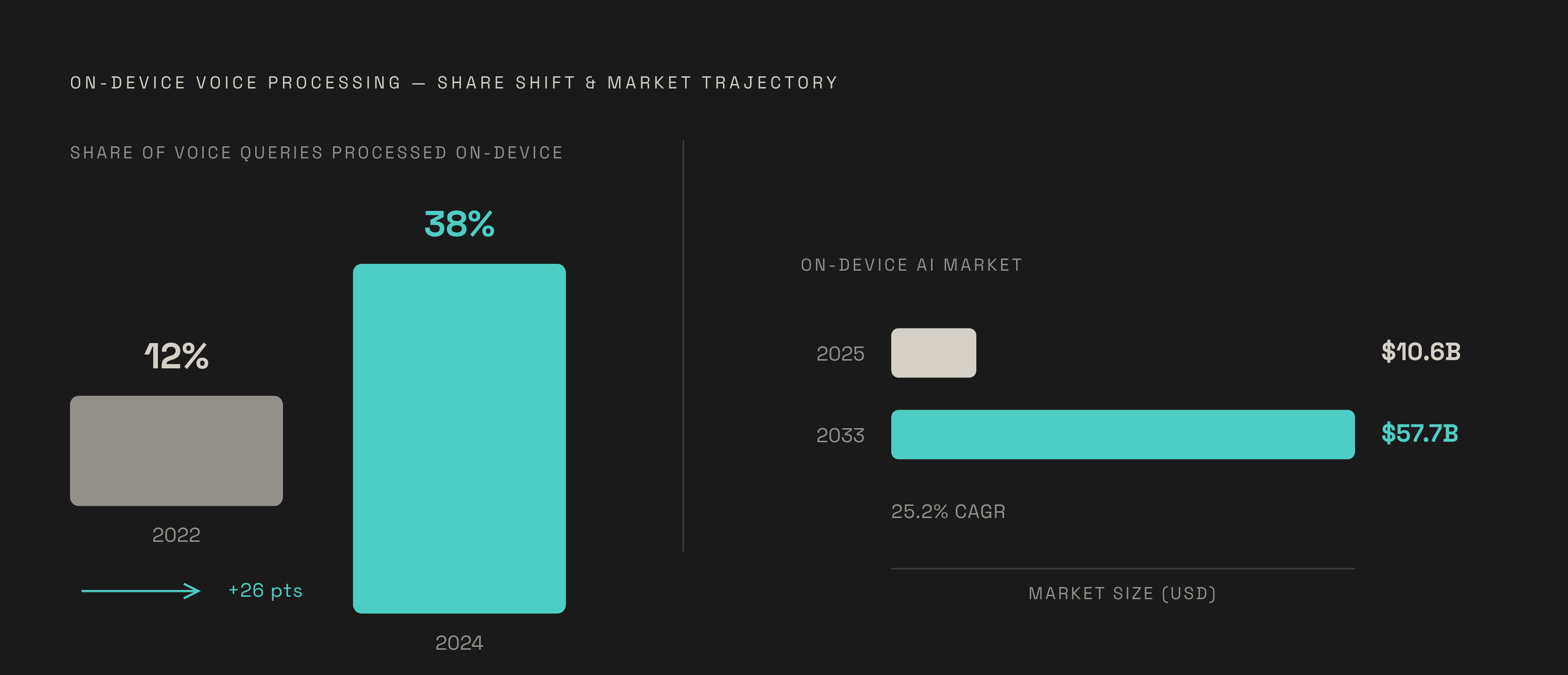
Something is shifting, and the change bears close tracking. On-device processing of voice queries grew from about 12% to 38% over a fairly short window, a meaningful directional change Voice Search Statistics 2026. A survey found that 47% of users say knowing that processing happens locally, rather than in the cloud, would increase their trust in a device Voice Search Statistics 2026.
Money is moving accordingly. The on-device AI market is projected to grow from $10.6 billion in 2025 to $57.7 billion by 2033, a 25.2% compound annual growth rate, as manufacturers build dedicated neural processing units directly into consumer hardware Voice Search Statistics 2026 jagadishwrites.com. Google's Gemini Nano, running on Pixel devices, is one concrete example, handling smart replies, summarization, and transcription locally rather than shipping audio to a server.
Apple's position is more complicated than its marketing suggests. At WWDC 2026, Apple introduced a rebuilt Siri with deeper personal context, but the company also acknowledged that the latest version of Apple Intelligence relies on technology developed with Google and cloud infrastructure running on Nvidia GPUs. That's a real departure from the original vision of on-device processing paired with Private Cloud Compute, even as Apple maintains its approach to privacy hasn't changed. Architecture is drifting toward the cloud even as the privacy language stays constant.
Amazon moved in the opposite direction from Google and, in some ways, from Apple's stated intentions. One of the largest platforms in the space, in other words, took a step backward on this exact dimension.
At the far edge of the spectrum sits a genuinely different approach. Home Assistant Voice, running a local Assist pipeline built on Faster-Whisper for speech-to-text and Piper for text-to-speech, processes audio entirely inside the home emersonsmart.com. The Preview Edition hardware runs around $59, and when cloud features are switched off, neither audio nor text ever leaves the local network emersonsmart.com. That's a useful data point precisely because it shows what's technically possible when a product is built around local processing from the start, rather than retrofitted with a privacy toggle.
But on-device processing doesn't erase every risk. It removes the transmission leg, which is significant, yet it matters enormously which features actually run locally and which still quietly depend on a cloud call. Marketing language about "on-device AI" sometimes describes only a fraction of what a device does.
Documented breaches, lawsuits, and incidents where voice data was exposed or misused
Theory is one thing. What's actually happened is another, and the record here is not short. In January 2026, a cloud transcription service left roughly 14 million audio files exposed to unauthorized access for at least seven months yaps.ai. Those files included medical dictations, legal depositions, and corporate meeting recordings, and the company behind it described the cause as a "configuration error" yaps.ai. Seven months is a long window for sensitive audio to sit unprotected yaps.ai.
Google paid a $68 million settlement over allegations that its voice assistant improperly recorded private conversations Voice Data Privacy 2026 yaps.ai. In Illinois, a judge approved a class of approximately 1.18 million users alleging that Amazon collected their voice biometrics through Voice ID without proper consent, a case still active as of April 2026 comparitech.com. Fireflies.AI faced a lawsuit over collecting biometric voice data without consent, adding another name to a growing list of companies facing legal exposure over how voice biometrics get gathered.
Attack surfaces are evolving too, not just legal exposure. In June 2026, researchers at SafeBreach Labs demonstrated a notification-based indirect prompt injection technique against Google Gemini on Android, using ordinary messaging notifications as the delivery mechanism. That's a new category of risk opened specifically by agentic voice AI, systems that don't just transcribe but act on what they hear.
Acquisitions carry their own quiet risk. When a company holding voice recordings, transcriptions, or voiceprints gets acquired, that data typically transfers along with everything else to whatever entity buys it, and the new owner may operate under a very different privacy policy than the one a user originally agreed to. On-device processing sidesteps this entire category of risk, since there's no centralized dataset to change hands in the first place.
Stepping back reveals a pattern. These incidents span accidental exposure through configuration errors, deliberate collection without consent, and newly discovered attack vectors like prompt injection. It's a spread of distinct failure modes, each requiring a different kind of vigilance.
What most users know, and don't, about their voice data
Survey data points to a strange kind of resignation. 56% of smart-assistant users say they're concerned about their data being collected, yet they keep using the devices anyway reviews.org. More than half, 52%, admit they've never read the privacy policy or terms attached to the product they use daily reviews.org. And 60% say they're specifically worried about someone other than the intended recipient listening to their recordings. (Those figures come from a Reviews.org survey; the precise publication date is worth confirming before treating them as current.)
What explains the gap between stated concern and continued use? Most people sense that something about the arrangement feels off, but they lack the specific, operational knowledge needed to act on that instinct, which is exactly the gap this piece is trying to close.
Default settings function as the real privacy policy for most households, whatever the written terms say. Any protection that requires a user to dig through a settings menu is, for practical purposes, invisible to the majority who never touch the defaults. It's a predictable design outcome, and the resulting information gap is structural rather than personal.
The gaps in legal protections within the regulatory environment
Illinois has the sharpest tool in the country. BIPA has produced significant settlements from major tech companies including Meta, Google, TikTok, and Clearview AI.
A recent example: Google agreed to pay $8.75 million to settle a class action alleging it collected and stored biometric data from Illinois students through its education platforms, with final approval landing October 17, 2025, and payments of $474.57 per approved claimant beginning February 13, 2026 claimdepot.com. Verizon faced similar litigation in 2024 over customers allegedly enrolled in voiceprint collection during service calls without written notice. McDonald's has dealt with a case, Carpenter v. McDonald's, over voice recognition technology at drive-through windows allegedly capturing audio characteristics tied to speech duration, pitch, national origin, gender, accent, and age.
Illinois isn't carrying this alone anymore. Texas SB 140 took effect September 1, 2025, Tennessee's ELVIS Act has protected voice as a right of publicity against AI cloning since July 1, 2024, and Colorado and Utah have added their own biometric overlays yaps.ai. That's a meaningfully wider legal map than existed even a couple of years earlier.
Federal rules move on a slower, more contested track. On December 11, 2025, an executive order established federal policy to challenge and seek preemption of state AI regulations viewed as overly burdensome, setting up direct tension with states running aggressive biometric statutes. California's 2026 legislative session has focused on consumer-facing AI, including chatbot interactions and digital replicas, with CPPA ADMT regulations requiring pre-use notice, an opt-out (or, in lieu thereof, an appeal to a human reviewer), access rights, and documented risk assessments for voice AI making significant decisions like loan eligibility, hiring screens, or healthcare triage.
Europe's baseline sits higher than any of this. GDPR treats voice recordings as personal data outright, requires explicit consent for biometric processing, and guarantees a right to deletion. In most places, though, the law alone isn't something a consumer can lean on entirely. The FCC's February 2024 TCPA ruling classified AI-generated voice calls as "artificial or prerecorded voice" calls under the TCPA, leaving statutory damages unchanged at $500–$1,500 per call, while an August 2024 NPRM proposing AI call disclosure requirements had not been finalized as of May 2026 under the Trump-era FCC.
What informed consumers can do: a practical framework for evaluating voice AI choices
So what does an actual decision-making process look like, given everything above? Four questions cover most of the ground. Where does processing happen, on the device itself or in the cloud? What's the default retention period, and is there a real opt-out or just a cosmetic one? Can a human listen to recordings, and is that opt-in or opt-out? And what happens to the data if the company gets acquired or shuts down?
Applied to specific platforms, those questions translate into concrete steps. On Alexa, that means enabling auto-delete, opting out of human review, and auditing which accounts and contacts are linked. On Siri, it means understanding which features route through Private Cloud Compute and which now depend on the Google and Nvidia infrastructure disclosed at WWDC 2026.
For anyone who wants to sidestep cloud transmission altogether, local-processing hardware already exists on the market. Home Assistant Voice, running its local Assist pipeline, keeps audio and text inside the home network entirely once cloud features are switched off, and the Preview Edition hardware costs around $59 emersonsmart.com.
A real design distinction separate from any single product sits at the core here. A system built from the ground up to keep data local operates on fundamentally different footing than a cloud-first system with privacy toggles bolted onto it after the fact. Understanding which category a product falls into, architecture-first or settings-first, is probably the single most useful lens for evaluating any voice AI device entering the market, now or later.
Voice is a biometric signal, an emotional signal, and in some respects a health signal all at once, and none of that gets captured by imagining it as words converted to text. Following the full path, from the microphone in a living room to the server rack somewhere unseen to the breach report that might one day name it, is what turns a vague unease about smart speakers into an actual, workable basis for choosing what belongs in a home.
Sources
- Voice AI in 2026: Inside the companies and investments shaping the future of speech
- Voice Search Statistics 2026: 100+ Data Points and Trends
- Voice Data Privacy 2026: How to Protect Your Voice From AI
- The State of Voice Data Privacy in 2026: Breaches, Laws & Defence
- Voice Assistant Statistics 2026: 8.4B Active Devices
- jagadishwrites.com