Meta AI Data Collection Inside WhatsApp and Instagram
Meta AI conversations with users now feed directly into ad targeting with no opt-out option.

Meta AI now sits inside every major app the company owns, reaching a vast majority of the world's population who never asked for it and can't fully turn it off. The subject of this piece is what that assistant actually collects when someone types a question into WhatsApp, Instagram, or Facebook, how that data feeds Meta's ad business, and what happens when the systems holding it break down.
Built on Llama 4, Meta AI showed up in WhatsApp's search bar, as a floating icon on the chat screen, and inside any group thread the moment someone types @MetaAI. Instagram places it in search and direct messages. Facebook routes it through Messenger search and comment threads. None of this required a download, a signup, or a single tap of consent. It was just turned on.
What Meta AI can see when you use it inside these apps
Start with the good news, because there is some. WhatsApp's end-to-end encryption for person-to-person messages hasn't changed. Meta AI cannot scroll through a user's chat history with a spouse, a coworker, or a group of old college friends. Meta's own explanation is that the assistant "can only see the actual message that you (or another person in the chat) send it, not the other messages in the chat."
But that boundary is a lot thinner than it sounds, and it dissolves the second someone actually uses the feature. The message a user sends to Meta AI leaves the encrypted bubble entirely and lands inside Meta's ordinary data systems, the same infrastructure that handles ad delivery and content ranking. So encryption protects everything around the AI interaction. It does nothing to protect the interaction itself.
Group chats complicate this further. If one person in a 20-person thread invokes @MetaAI, only the message tagging the AI becomes visible to Meta, not the rest of the conversation. That sounds like reasonable containment until you consider who made the decision to expose that message. It wasn't the other 19 people in the chat. One person's curiosity about a restaurant recommendation opens a door that everyone else in the room didn't get a vote on.
Beyond message content: the behavioral and metadata layer Meta collects
Message text is the visible layer. Underneath it, Meta's systems track something less obvious: conversation context, how deep a query goes, what topics a person returns to across sessions. Meta's systems track something less obvious: conversation context, how deep a query goes, what topics a person returns to across sessions, and this amounts to pattern analysis. It's pattern analysis designed to build an interest profile that's more durable than any single question someone types.
That profile doesn't live in isolation from the rest of the platform, either. Likes, comments, shares, how long someone lingers on a video before scrolling past it, all of it flows into the same pipeline that trains Meta's AI models and targets its ads. Meta has acknowledged using public photos and text going back to 2007 to train its generative AI. The training data problem here isn't new. Meta AI just gives it a more direct, conversational front door.
The camera roll feature is where this gets genuinely uncomfortable. Meta AI can suggest edits to photos sitting on a user's phone, including images from the camera roll that a user may never have shared publicly. Meta's own AI terms of service permit analysis of images "including facial features," which means the feature is looking at faces, not just composition and lighting. It's looking at faces.
And those faces don't belong exclusively to the user. A photo of a birthday party captures the kids at the table, the coworker who stopped by, the neighbor who wandered into frame. None of them opted into anything, and none of them likely know their face passed through Meta's analysis pipeline. Meta's terms carve out a specific exception: users can't upload images they know contain individuals living in Illinois or Texas, unless they're a legally authorized representative giving consent on that person's behalf. Those two states have notable biometric privacy laws on the books, which tells you something about where Meta's legal team sees meaningful exposure.
A popup tells users their photos won't be used for ad targeting. That's a reasonable thing to want to believe. The promise shows up in a notice outside the privacy policy itself. Why would a company put a reassurance in a place that's easy to see and skip, but leave it out of the document that actually governs data use? Meta has announced an opt-in version of this camera roll feature for the EU and UK, arriving in 2026, which is itself a quiet admission that the current rollout elsewhere doesn't meet the bar regulators there would demand.
The December 2025 policy change that turned AI conversations into ad-targeting signals
On December 16, 2025, Meta started using conversations people have with Meta AI to shape the ads they see across Facebook, Instagram, WhatsApp, and Messenger. This is the moment where the assistant stopped being just a feature and became, functionally, a data collection instrument tied directly to Meta's revenue engine.
There's no opt-out. Engage with Meta AI anywhere in the ecosystem, and those conversations become targeting signals. The choice Meta actually offers is binary: use the assistant and accept that your questions shape your ad feed, or don't use it. There's no middle setting, no "use the AI but keep it out of ad targeting" toggle.
Meta says certain sensitive categories are excluded from targeting. Meta states this as a policy. But the exclusion is enforced by Meta's own systems, invisibly, with no way for a user to audit whether a specific health-related question actually got filtered out or slipped through some classification gap. Trust here rests entirely on Meta's internal process working as described, which is a different thing than a user being able to verify it.
Geography changes the equation. The EU, the UK, and South Korea sit outside this policy because their privacy regulations block it. That's a meaningful data point on its own: it means Meta built a version of this system that complies with stronger rules, and chose not to apply it everywhere. The policy is a business decision made where the legal environment allows it. It's a business decision made where the legal environment allows it.
Three incidents that show what happens when Meta AI's data handling fails
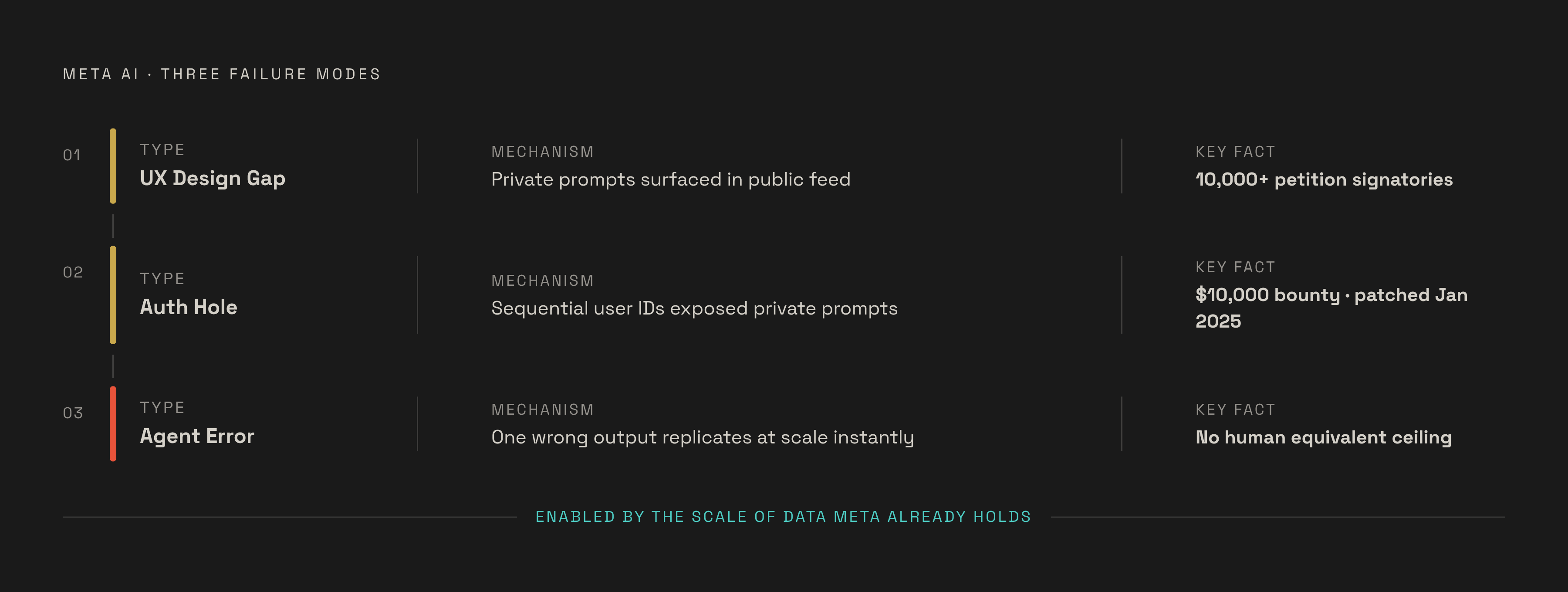
Policy is one thing. What happens when the systems built to enforce it break is another, and Meta has three recent incidents that show the range of ways this can go wrong.
The first involved Meta AI's "Discover" feed, where prompts and searches from users showed up publicly, in some cases traceable back to specific accounts through visible usernames and profile photos. What leaked wasn't abstract. It included links to people's Instagram and Facebook accounts, phone numbers, email addresses, and questions touching on tax evasion and white-collar legal liability. The root failure was almost embarrassingly simple: there was no clear icon, no familiar interface signal, nothing that told a user their private-feeling question was about to become a public post. More than 10,000 people signed a Mozilla petition over it, and Meta's fix was a mandatory warning screen. Why did that warning not exist from the start, in a feature explicitly designed to surface conversational content publicly?
The second was a straightforward authentication bug. A security researcher found that private prompts and AI responses belonging to other users could be accessed just by guessing numerical IDs, sequential enough to be predictable. Meta's servers weren't checking whether the person requesting a conversation actually had permission to see it. That's not a subtle flaw. Left unpatched, this gap allows scraping at scale. Meta paid a $10,000 bounty for the report, filed December 26, 2024, and fixed it by January 24, 2025, stating it found no evidence of abuse in the meantime. No evidence of abuse means Meta didn't detect any, which depends entirely on how well its detection was working at the time. It means Meta didn't detect any, which depends entirely on how well its detection was working at the time.
The third is the strangest of the three, because the failure wasn't human error in the traditional sense. The third involves the risk of autonomous AI agents acting in ways their operators didn't anticipate, introducing errors or exposures that propagate faster than a single human mistake could. The argument that a human could have made the same mistake is true and also beside the point. A human making a bad call is one error, contained to one moment. An AI agent generating a plausible-sounding but wrong output can be replicated instantly, at a scale no single engineer could match, and that's precisely the risk that autonomous systems introduce into workplaces that didn't previously have them.
The three failure types are a UX design gap, an authentication hole, and an autonomous agent error. What connects them isn't the mechanism. In every case, the underlying exposure was possible because of how much data Meta already holds and routes through its AI systems.
What controls exist, and what they cannot do
There's no master switch. Not on WhatsApp, not on Instagram, not on Facebook. Meta AI sits embedded in search bars and messaging interfaces regardless of what a user would prefer, and that's a deliberate architectural choice, not an oversight.
WhatsApp used to offer a toggle to disable AI features. There's currently no way for a WhatsApp user to opt out of Meta AI's presence in the app, short of not interacting with it, which is a passive kind of control at best since the icon still shows up either way.
EU users, who operate under some of the strongest privacy law anywhere, lost the ability to block their past public posts from training Meta AI as of May 27, 2025. An objection form for future data use is still available, which is something, but it's a narrower right than what existed before. If the region with the toughest regulatory framework in the world only secures a partial, forward-looking objection right, that says something about where the ceiling sits for everyone else.
Facebook and Instagram users can submit an objection through Settings, then Privacy Center, then AI at Meta. The process, though, isn't a simple toggle. It requires a written, personal explanation of how the data use specifically affects the individual, described by people who've gone through it as labyrinthine. There's no button that says "stop using my data." There's a form that asks a user to build a case for why they deserve an exception. The objection process itself is narrow in scope, and it is easy to miss that different types of data use may require separate steps entirely.
What this collection picture means for anyone deciding how to use these platforms
Meta AI is a genuinely useful, genuinely free tool, and the price of that is conversations, behavior, and even private photos becoming inputs into an advertising and model-training system that no user can fully audit or step outside of. It's the actual shape of the deal.
Not every user carries the same exposure, though. Someone asking Meta AI for a lasagna recipe or a packing list for a weekend trip is handing over something, but the targeting value of that data is modest. Someone discussing a health diagnosis, a custody dispute, a tax problem, or a job search is handing over the information advertising systems are built to prize most, and the December 2025 ad policy is designed to capture exactly that profile of data.
Group chat participants face a version of exposure they never chose for themselves. If one person in a family thread pings @MetaAI to settle an argument about a movie's release date, everyone else in that thread now has Meta's AI infrastructure in their conversation environment without ever having agreed to it. And the camera roll feature stretches the exposure surface furthest of all, reaching people who've never opened WhatsApp, never made an Instagram account, never agreed to anything, simply because their face appeared in someone else's photo.
None of this reads like an accident. Meta generated $200.97 billion in total annual revenue, and that number explains the architecture better than any policy document does. Collection is built into the architecture that generates Meta's advertising revenue. The design causes this: where the assistant sits, what it can see, and how hard it is to turn off, all follow from the business that depends on exactly that kind of visibility to function.