AI Provider Terms of Service and the Consent Theater Problem
Unilateral terms and dark patterns let AI providers claim consent while users lack genuine choice.

AI provider terms of service turn a click into permission over data, outputs and legal risk. In consent theater, this permission can look informed while the conditions for meaningful choice are missing. Understanding the contract helps, but disclosure alone cannot fix the imbalance. Genuine consent requires limits built into both the agreement and the system it governs.
How AI terms of service became a substitute for regulation
Generative AI providers are writing rules for questions that courts have not yet resolved and legislatures have been slow to address. Their terms of service determine who owns what users create, who bears responsibility for outputs, how data may be used and which dispute processes remain available. These conditions help define the product’s relationship with the people who use it. Yet the provider writes them, and access depends on acceptance.
That arrangement gives private contracts a role that would otherwise belong to public deliberation and impartial regulation. A user cannot negotiate the rules simply by reading them more carefully. Agreeing to the terms also does not prove that the provider has divided rights fairly. If those allocations become entrenched before regulation arrives, they become the starting point against which later protections must work. The concern is therefore not just what today’s terms permit, but how they narrow tomorrow’s choices.
What "consent" actually means in a ToS you cannot negotiate and may never read
Clicking “I agree” supplies the form of agreement without necessarily supplying its substance. Meaningful consent requires understanding what is proposed, a genuine ability to decline and terms that remain stable after acceptance. A document can be binding even when those conditions are not met. The person who accepts it must be able to judge what permission to give.
AI terms routinely weaken that capacity. Terms of use are not well understood, even though they carry legal consequences. Meanwhile, declining a take-it-or-leave-it contract means losing access, which is a constrained choice when tools are embedded in professional and educational life. This makes the click poor evidence of informed authorization. The distinction matters because the mechanisms that follow exploit precisely that gap.
The four mechanisms that manufacture agreement without it
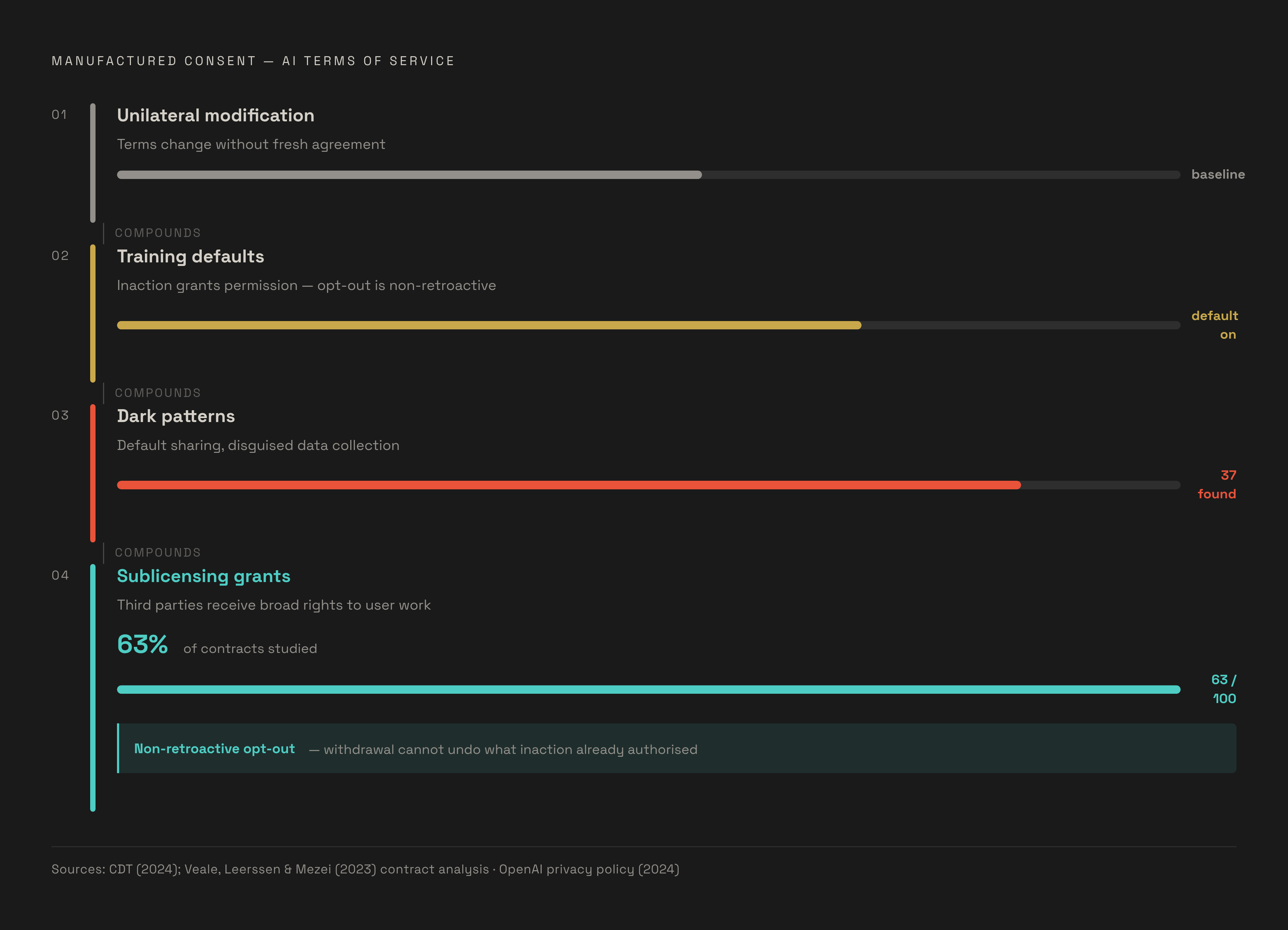
Unilateral modification rights first defeat the requirement of stable terms. A large majority of AI contracts allow providers to change terms without obtaining fresh agreement, and a significant share do not require notification. Reading at sign-up therefore cannot establish what will govern later use. The FTC has warned that retroactively adopting more permissive data practices through a buried amendment may be unfair or deceptive. Its description of “artificial consent” captures the substitution of a provider’s revision for a user’s decision.
Training defaults then shift the burden from granting permission to withdrawing it. OpenAI uses conversations for training by default on Free, Plus, and Pro personal accounts, while business tiers and the API are opted out by default. The personal-account opt-out is non-retroactive, so it does not reverse prior use. Google Gemini activates “Gemini Apps Activity” by default for users 18 and older, collecting chats, files, images, feedback, and location. These arrangements make inaction carry consequences that a user may never have considered.
Dark patterns can make the supposed route out difficult to understand or use. The Center for Democracy and Technology found 37 dark patterns in AI chatbots, including default sharing, disguised data collection, and coercive consent. Such designs compromise both comprehension and the ability to decline. A formal control is not enough if the interface obscures what it controls. Defaults and interfaces that are hard to use thus strengthen each other, while neither acts as a check on the other.
Sublicensing and open-ended grants for business use allow uses beyond the service itself. Newman and Sawicki’s working paper found sublicensing rights in 63% of the contracts they studied, so users could keep copyright in name while third parties had broad rights to use their work. Adobe’s June 2024 clarification and rewritten terms show how hard these grants can be for users to understand. Adobe said it had never trained on customer content and explicitly promised it never would, after concern about language that had been live since February 2024 surfaced during re-acceptance.
How liability flows to users while control stays with providers
The same architecture also assigns responsibility for outputs to people who cannot control how those outputs are produced. Pandit et al.’s FAccT '26 analysis of six generative AI services found that users were solely responsible for outputs meeting provider-dictated norms, despite lacking information or control over model functioning. Failure could put their accounts at risk. All the terms also discarded assurances about quality, availability, and appropriateness, whether the service was free or paid.
Copyright makes that mismatch especially sharp. Probabilistic outputs can put even users who try in good faith to avoid infringement at risk, yet a large majority of the contracts reviewed required users to indemnify providers against third-party copyright claims. This is the “copyright crumple zone” dynamic, in which users absorb exposure generated by a system they do not govern. X’s January 2026 terms sharpen the contrast by capping users’ recovery at $100 while granting X a perpetual, worldwide content license and calling access “sufficient compensation”.
Why enterprise and cross-border use makes the problem materially worse
When an employee pastes a document into an AI service, the organization’s information becomes subject to that service’s terms. Personal data may also travel to jurisdictions where home-country privacy protections do not apply. Because AI terms often fail to disclose clearly where data travels, an organization can struggle to identify the legal conditions governing the transfer. The employee’s click does not settle those obligations.
The Irish Data Protection Commission opened a formal proceeding on April 11, 2025 under the GDPR into X’s use of data from its platform’s users to train Grok. That proceeding is still open and is the first major enforcement action under GDPR to directly target the use of data for AI training. It makes the distinction between access to data and lawful permission to train on it concrete. Similarly, generic language about “improving our services” leaves organizations on legally uncertain ground when relied upon as an AI training disclosure under GDPR and CCPA. A vendor agreement can record acceptance without resolving whether the organization had authority to grant the permission.
What regulators have done so far and where enforcement still falls short
Regulation has begun to address these relationships, but its timetable is uneven. From August 2, 2026, the EU AI Office and national authorities began enforcing the AI Act, and Article 50 transparency duties apply to systems that interact directly with users. Those duties require disclosure that the user is interacting with an AI system. The Digital Omnibus on AI, in force July 27, 2026, pushed most high-risk obligations to December 2027 for Annex III stand-alone systems and August 2028 for Annex I product-embedded systems. It left prohibited-practice rules, GPAI obligations, and transparency requirements on their original timeline.
As of October 2, 2026, no verified AI Act monetary fine had been issued, leaving its deterrent effect on terms practices untested. At the federal level, the FTC’s warning that there is “nothing intelligent about obtaining artificial consent” signals an enforcement position, but not AI-specific rulemaking that closes the default-collection gap. At least twenty U.S. states have comprehensive privacy laws that intersect with AI processing, with inconsistent requirements. Unilateral modification, sublicensing and liability shifting are not directly targeted by any current enforcement action described here. Meanwhile, dark-pattern consent flows raise concerns under consumer protection, GDPR and AI Act transparency rules, but no single authority has taken action that covers them all.
Why agentic AI makes the existing consent model structurally obsolete
Agentic AI changes what an initial agreement is being asked to authorize. A chatbot user submits a prompt and reviews an output, but an agent can make purchases, send communications or access data across third-party services without per-action review. Permission must now cover actions in contexts the user may not have anticipated. Whether that document can define a meaningful boundary for delegated action now matters alongside whether the user understood it.
On August 4, 2026, the Ninth Circuit vacated a preliminary injunction Amazon had won against Perplexity’s Comet shopping agent. The ruling raised unresolved questions about terms binding an agent acting for a user and responsibility when its actions exceed the user’s authorization. The court left open whether the agent itself could gain unauthorized access on a different record. The ruling leaves the limits of permission for agent access unresolved. Neither the EU AI Act, GDPR nor FTC guidance directly resolves responsibility for an agent’s out-of-scope actions under user authorization.
What meaningful consent in AI would actually require
Meaningful consent would start with functional disclosure: terms would state whether inputs train models, how long data is retained, whether it is shared with third parties and whether users can opt out. They would explain anonymization or aggregation and what happens when a subscription ends. Material changes would require affirmative re-consent even from users who continue using the service. Sublicensing would be limited to operational need, and liability would not be assigned to users for outputs they cannot control.
However, better language would still leave the underlying data relationship intact. Privacy-preserving architecture offers a structural contrast because it can keep user information under the user’s control from the start. Where data is not retained, a later contractual amendment cannot simply authorize a new use of that retained data. That is different from a promise not to sell information while keeping broad training rights. The protection rests on what the system can do as well as what its current terms say it will do.
The strongest objection is that training on user data improves models and that opt-out controls adequately protect people who care. That argument depends on withdrawal being a genuine, usable choice. The documented dark patterns show why having a control alone does not ensure that choice. Privacy-preserving architecture also shows that capable AI can work without turning user information into data for training. The tradeoff is therefore not simply better models against more privacy, but which design choices make those goals appear inseparable.
What users and organizations can do before regulation closes the gap
Users can check whether inputs train models by default, whether withdrawal is non-retroactive and whether terms can change without agreement or notice. Users can check sublicensing terms because the permission they give may reach third parties as well as the provider. Indemnity provisions show whether users must cover copyright claims from outputs they cannot control. Dispute clauses likewise show whether acceptance waives class action rights or requires binding arbitration in an inconvenient jurisdiction.
Organizations need to map which AI services employees use and the terms governing each one. Enterprise agreements deserve scrutiny too, rather than an assumption that a business account resolves every consent problem. Organizations that send EU personal data to U.S.-based AI services need a lawful transfer mechanism and cannot assume that standard terms provide one. Privacy policies and terms should also align, because contradictions create enforcement risk under GDPR and CCPA. These steps turn an abstract concern about consent into an examination of actual permissions and exposure.
Users still need to watch for notices of changes when terms allow unilateral modification. Yet vigilance cannot make unstable terms stable, and clearer notices cannot by themselves create genuine choice. Where the choice exists, users and organizations can prefer providers whose architecture structurally limits data collection. Regulatory transparency duties may improve disclosure, but disclosure is not the same as control. The more durable protection is a system that does not collect the data in the first place, rather than a favorable promise that can change tomorrow.