Architectural Privacy vs Policy-Based Privacy in AI Systems
AI systems leak data where policies were never designed to reach.
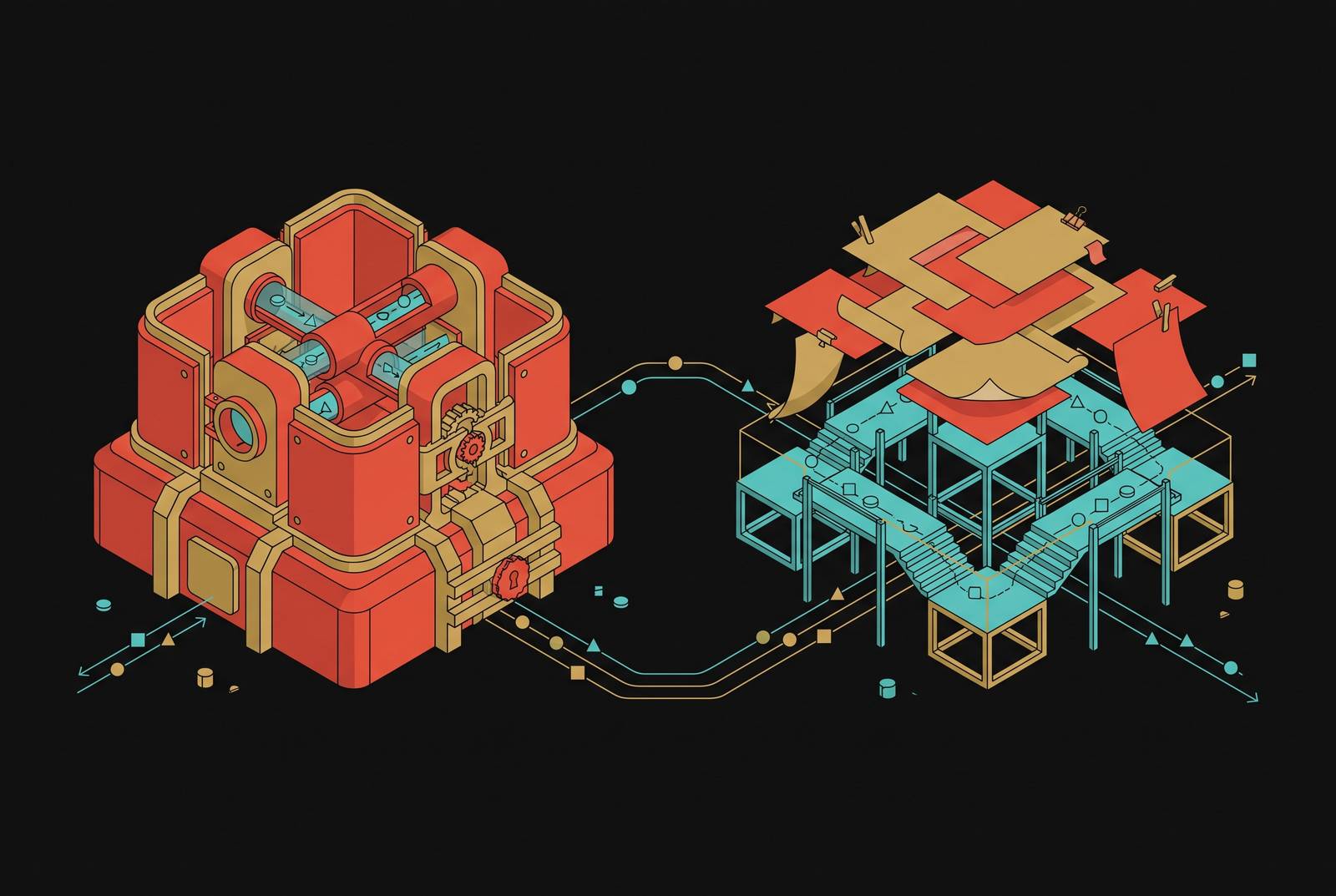
Policy-based privacy assumes a world where organizations know what data they hold, why they hold it, and who can touch it. ISACA's 2026 analysis lays out the specific ways AI dismantles the old assumptions: models train on vast, unstructured datasets rather than defined fields in a database; they infer sensitive attributes, health conditions, financial stress, political beliefs, from data that looks harmless on its own; and they operate at speeds that make human review at each decision point impossible. None of this fits inside a framework built around GDPR articles and HIPAA checklists, which assumed a human could trace a data flow from collection to deletion. ISACA states that a privacy professional equipped only with those checklists is "simply not equipped for this environment, the tools are wrong for the problem.
The structural difference between a policy promise and an architectural constraint
A policy describes a decision someone made and can unmake. An architecture describes what a system is able to do in the first place, and that difference changes what kind of guarantee a reader is actually getting. Consider two statements that sound similar but aren't: "We do not sell your data" is a promise about behavior, one that depends entirely on whoever made it continuing to honor it, and on the data having already reached a server where that decision even applies. "The system has no technical path to send your data anywhere" describes what the system can do, and it holds regardless of anyone's intentions, because there's no channel to misuse.
Policy can change quietly. Architecture resists that kind of quiet reversal. ISACA frames the resulting shift directly: "if privacy is not enforced technically, it is not enforced at all." In a system running at machine speed, the only behavior that reliably holds is the default behavior built into the system, because no one is watching each individual transaction to make sure a rule gets followed.
The same logic applies inside an organization, not just between a vendor and its customers. A pipeline engineered so that collecting data beyond defined parameters is technically impossible enforces that same minimization no matter what any individual employee does or forgets to do.
Where AI systems leak data
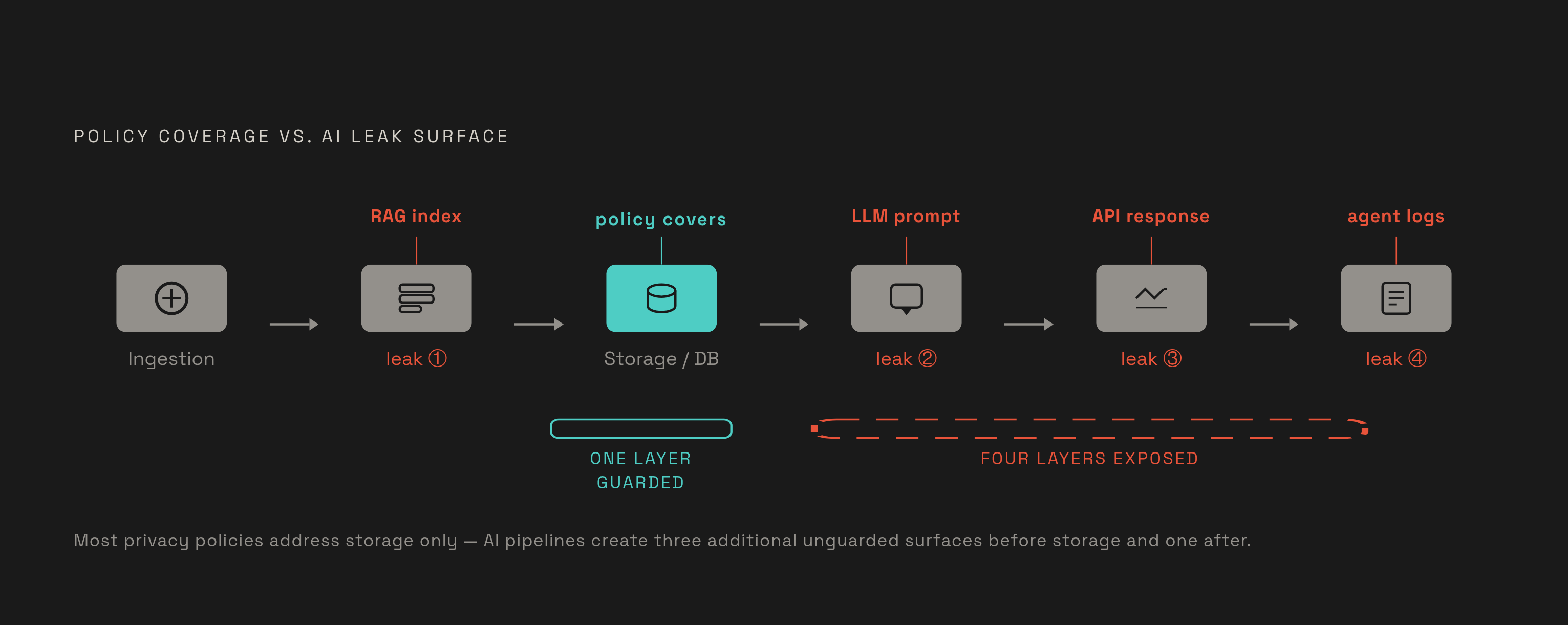
Most AI data exposure happens at the points where data moves and gets processed, not at the storage layer that most privacy policies are written to cover, places that policy documents were never built to reach. Production analysis identifies four consistent leak points in real AI systems: LLM prompts, RAG indexes, API responses, and agent logs. Notice what these have in common: none of them is a traditional database.
A retrieval-augmented generation system makes the problem concrete. Say a customer support assistant retrieves account context to answer a billing question, and the index it pulls from contains another customer's account number because that record sat near the query in vector space. A policy stating "do not expose PII" offers no mechanism to stop this, because it has no presence inside the vector index where the mistake actually happens.
Standard masking shows the same structural gap from a different angle. Redacting a name to [NAME] or blanking out an email address often causes a model to hallucinate or breaks a downstream tool call that depended on the real value. Most of the real risk in production AI, as the same source puts it, "sits between storage and model, in embeddings, vector indexes, and agent tool calls that nobody scanned." A policy document has no foothold at the prompt layer, the vector index, or the agent log, because those layers didn't exist when most privacy policies were written.
What architectural privacy does at each of those points
Architectural privacy is a set of technical choices made at design time that place real constraints at every point data moves, including where it sits at rest. Each technique targets a specific leak point identified above, and each works by removing a decision from human hands.
Differential privacy adds calibrated mathematical noise to a dataset or its outputs, so the effect any single person's data has on the result stays within a provable bound. Identifying one individual from the output becomes statistically infeasible because the math makes it so. That's a formal guarantee, not a procedural commitment someone could choose to skip.
Context-preserving tokenization works at the point of ingestion, detecting sensitive entities and swapping them for format-retaining tokens before the data ever reaches the model. The model processes the token the same way it would process the real value, so accuracy holds up without raw personal data ever touching the model itself. This control sits at the prompt layer, exactly where the standard-masking failure described above occurs, not buried in a database policy somewhere downstream.
Role-based access control set at the agent level, rather than only at the database, closes the gap left by systems where an agent can call tools and take actions the database's access rules never anticipated. Tamper-proof audit logs add a different kind of value: verifiable evidence of what data moved and when, which matters increasingly because regulators and enterprise buyers are asking for proof.
What ties these together is that each one takes a human decision point out of the enforcement chain. The constraint lives in what the system can do, so no single person's mistake, bad judgment, or compromised account can override it. It also comes with real computational overhead that makes it impractical in plenty of production settings. That's a genuine limit on the architectural toolkit, not a reason to dismiss the approach.
Confidant AI exemplifies this distinction: rather than relying on policies about data handling, it's built on privacy-preserving architecture from the ground up so that data stays with the customer who owns it. The system has no technical path to collect or monetize that data, because those capabilities are architecturally absent.
The regulatory shift from accepting policy documents to auditing technical implementation
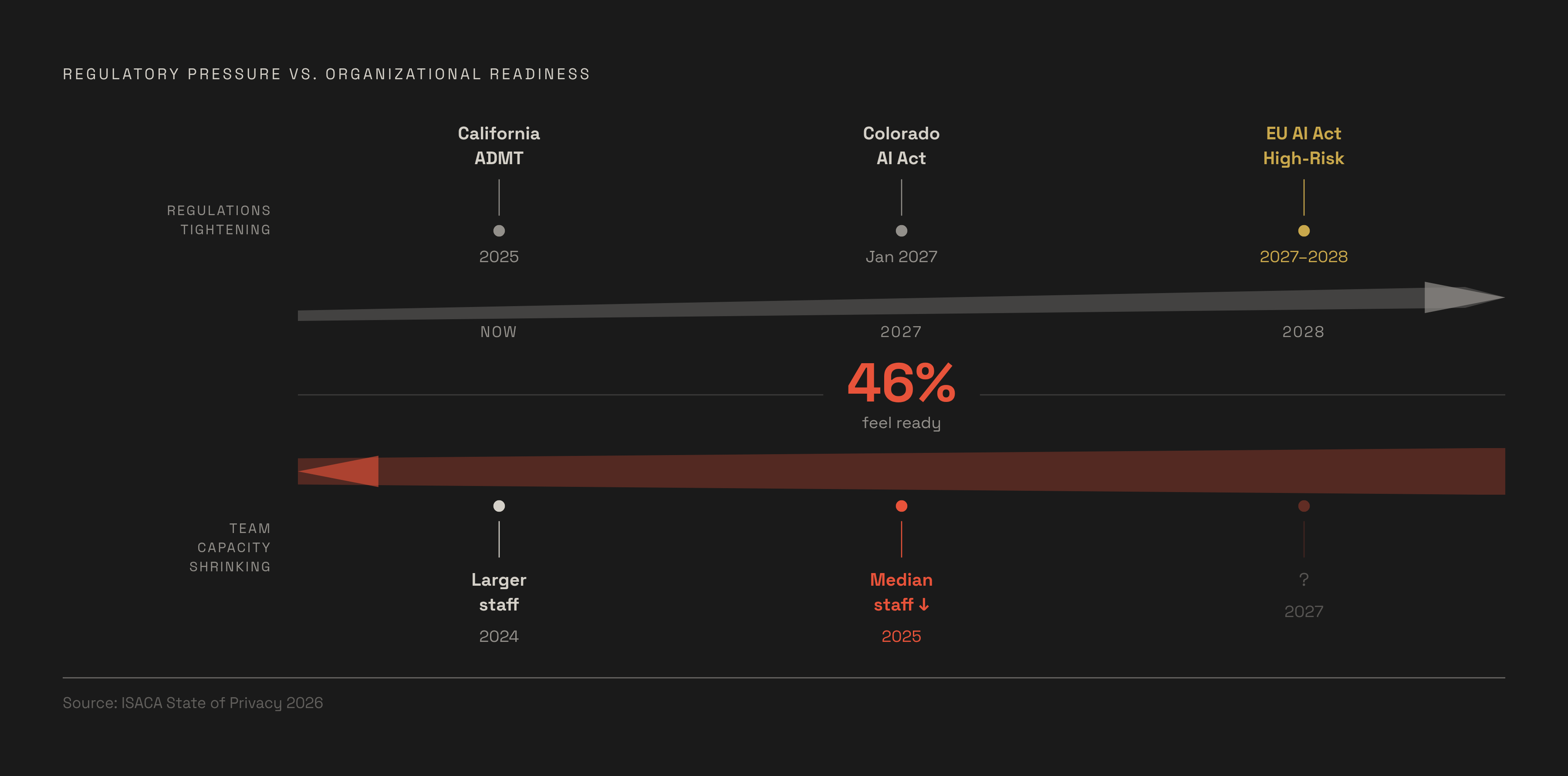
Regulators have stopped evaluating what organizations say they'll do and started checking what their systems actually do, and that shift turns architectural privacy from a nice-to-have into a compliance requirement. The EU AI Act introduces risk-based requirements that push privacy into the development process itself rather than leaving it as something assessed after a system ships, with high-risk system requirements phasing in across 2027 and 2028. California's Automated Decision-Making Technology Regulations, adopted by the California Privacy Protection Agency in July 2025 and finalized once the Office of Administrative Law approved them in September 2025, mark the state's first finalized rules aimed specifically at algorithmic decision systems under the CCPA and CPRA. Colorado's AI Act, taking effect January 1, 2027, sets obligations for developers and deployers of high-risk AI systems around algorithmic discrimination and transparency.
Enforcement is increasingly visible in how regulators now test compliance. Automated tools now check whether a "Reject All" cookie button actually stops trackers from firing, and if it doesn't, the organization is liable regardless of what its privacy policy says. That's technical auditing replacing document review. A paper published through the IEEE finds that AI governance instruments increasingly demand "privacy by design" and "privacy by default," but rarely spell out what counts as sufficient technical implementation or audit evidence. Across every jurisdiction named here, the common thread is the same: privacy as something an organization discloses is giving way to privacy as something an organization builds, where technical design and verifiable user control decide whether a system actually complies.
Enforcement outpaces organizational readiness
Right as regulation starts demanding architectural enforcement, most organizations are moving in the opposite direction, pulling back from privacy-by-design practice while running smaller teams with gaps in the technical skills the work now requires. ISACA's 2026 State of Privacy report found that fewer organizations practiced privacy by design when building new applications than did the year before, a decline arriving at the exact moment regulatory pressure went up. The same report found median privacy staff size dropped significantly in a single year, and fewer than half of respondents, 46%, said they felt very or completely confident in their privacy team's ability to meet new privacy laws and regulations.
The shortfall is a mismatch in skill sets, not simply a matter of headcount. Reviewing a data processing agreement calls for legal training. Tracing how personal data flows through a microservices environment, checking whether a third-party SDK is quietly sending data somewhere it shouldn't, or configuring a consent management platform to correctly honor granular consent signals calls for technical skills that a legal-to-privacy career path rarely builds. One survey found more than a quarter of organizations haven't verified whether their AI vendors use the data submitted to them for model training, so a meaningful share of enterprises are sending sensitive data into third-party systems on contractual trust alone, with no technical check behind it.
That's exactly the vulnerability policy-based privacy can't close: when an organization has no way to verify what a vendor's system does with its data, a strong privacy clause in the contract provides no technical protection. The same gap appears inside "privacy by design" mandates themselves. Because governance instruments rarely define what counts as sufficient technical implementation, a documented architectural intent can end up substituting for architectural enforcement that was never actually verified, a kind of policy-washing dressed up in engineering language.
Evaluating whether an AI system's privacy claims are architectural or merely promised
Judging whether an AI system's privacy claims hold up means asking what it's technically capable of doing with data, not merely what it promises to do. That's a question about architecture, and it can be answered with a short set of concrete questions that apply to any AI vendor, not just one.
The first and most useful question to ask: does the system need a user's data to reach an external server? From there, ask where data minimization actually happens. If it lives in a procedure document or a line in a contract, it's policy. If it's enforced at the ingestion pipeline, where data gets tokenized or masked before any model sees it, it's architecture.
Ask next where access controls are actually set. Closing that gap requires setting controls at the agent level itself. It's also worth asking what happens if a vendor changes its terms. An architectural system's properties stay bounded by what the system is actually built to do, so a new clause in a terms-of-service update can't quietly grant access to data when no technical channel for that access exists.
One more test cuts through a lot of marketing language: can the vendor actually verify its own claims? Tamper-proof audit logs and independent technical audits count as evidence. A page describing a privacy policy does not, no matter how detailed it reads. The gap between policy intent and technical reality is why some AI systems build architectural constraints into every transit layer, prompt handling, indexing, and inference, rather than relying on access controls that stop at the database and leave the rest of the processing pipeline exposed. Confidant AI's approach illustrates what an affirmative answer to these questions looks like in practice: the architecture is built so the system has no technical means to collect or use submitted data, which makes that privacy property a function of what the system can do rather than a commitment that a future policy update could quietly undo.
Why architectural privacy outlasts policy
Building privacy into architecture costs more and runs into real technical limits. The strongest objection from people who actually build these systems is that architectural privacy isn't yet practical everywhere: IoT devices and speech systems still lean on policy-based mitigations because computational limits and real-time processing demands put cryptographic computation out of reach, and homomorphic encryption adds overhead that plenty of systems simply can't absorb. That objection deserves to be taken seriously. Architectural privacy hasn't been solved across every deployment context, and claiming otherwise would just be a different flavor of the policy-washing this piece has been describing all along.
But that objection doesn't rescue policy as a substitute. A system that can't yet enforce architectural constraints carries an unresolved privacy risk, full stop, and a policy sitting on top of that system doesn't close the gap. It just covers it over. ISACA frames what comes next as a convergence between privacy engineering, security, and AI governance, and organizations that keep treating these as three separate policy functions will move slower and stay more exposed than the ones that fold them into a single set of technical controls. The direction regulators are moving, toward auditing what systems actually do rather than accepting what their policies say, means organizations building architectural privacy now are building toward the compliance standard that's coming, not away from it.
What makes the distinction worth the extra engineering effort, in the end, comes down to durability. A policy is only as strong as the last person who agreed to it and the next person with the authority to change it. An architecture enforces its constraints on everyone bound by it, including future owners of the company, future regulators writing new rules, and future attackers looking for a way in. That asymmetry, between a promise that depends on who's currently in charge and a constraint that doesn't, is why an architectural constraint outlasts any privacy policy's wording, since it binds everyone regardless of who currently holds power.