AI Startup Data Practices When Companies Are Acquired or Fail
User data becomes a sellable asset when AI startups fail or get acquired.
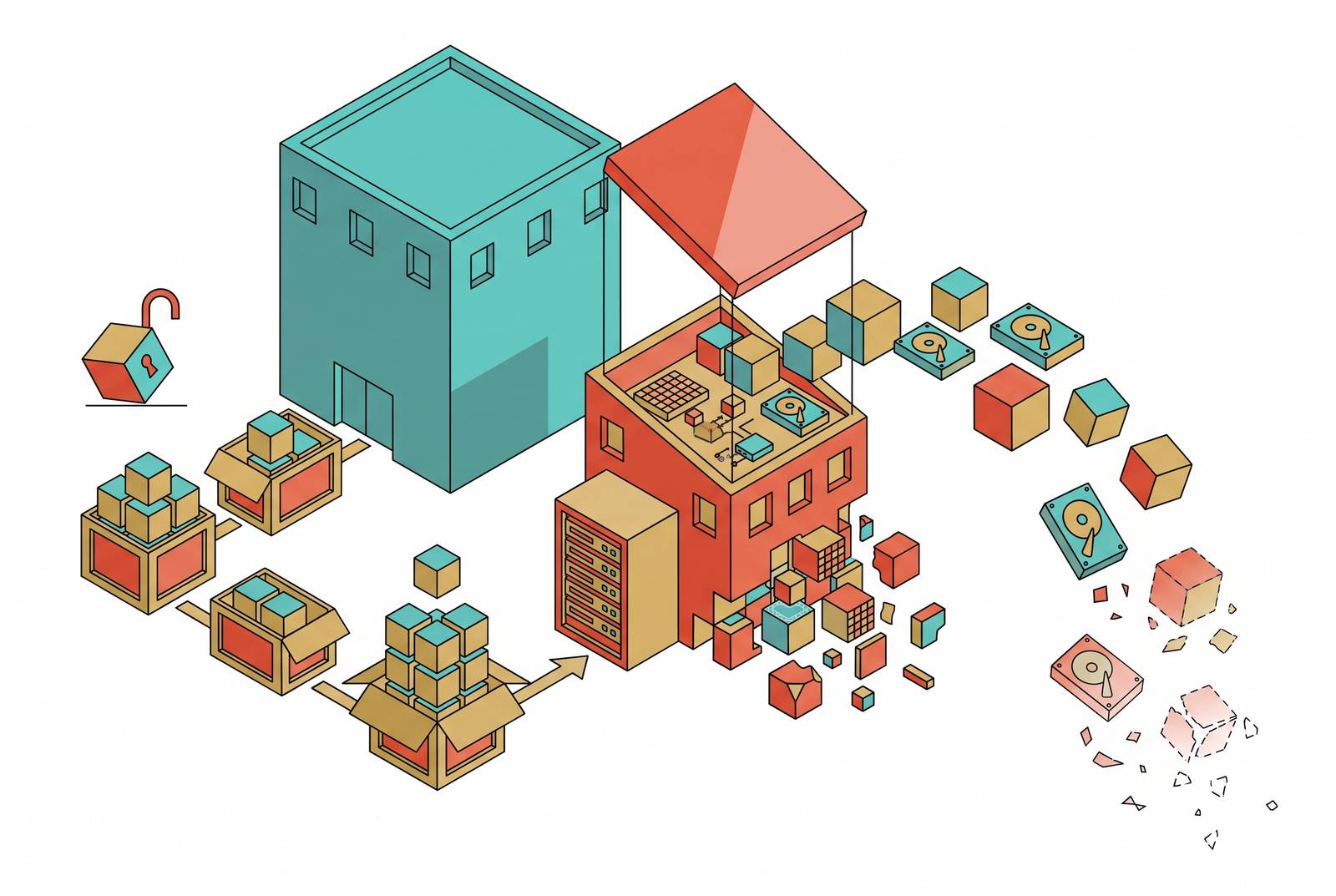
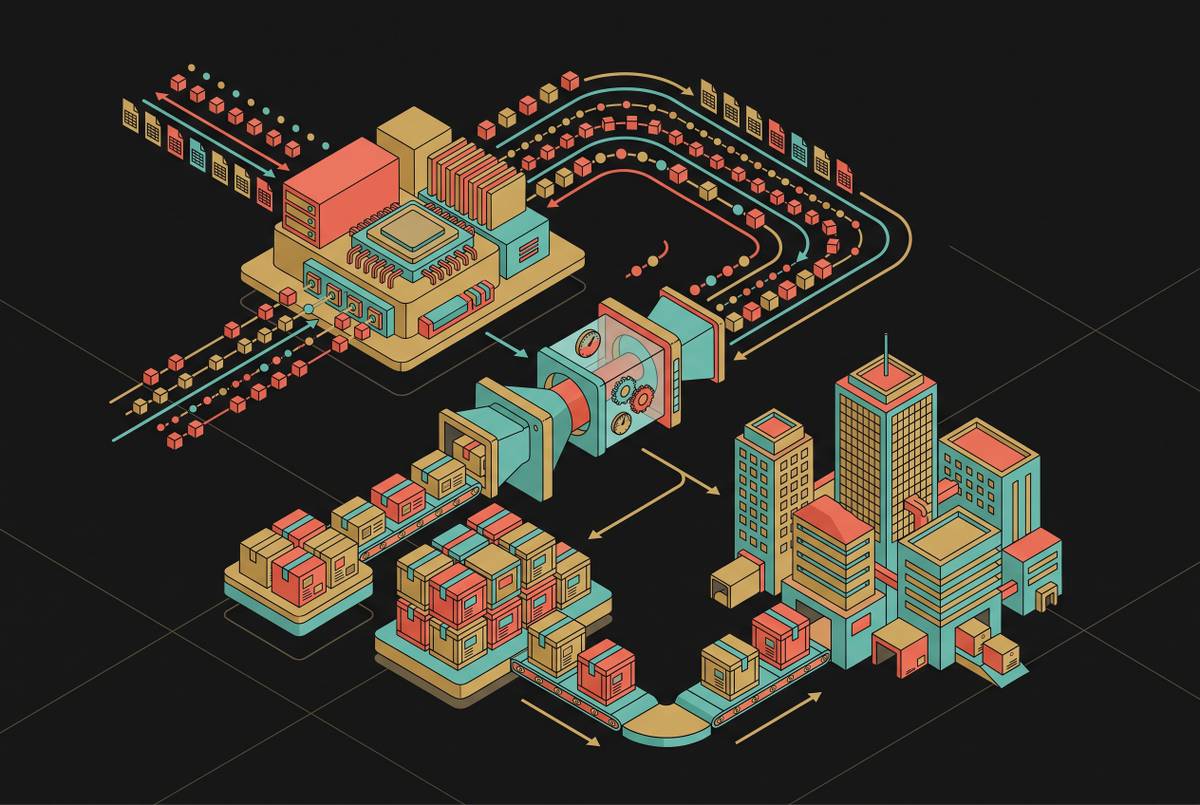
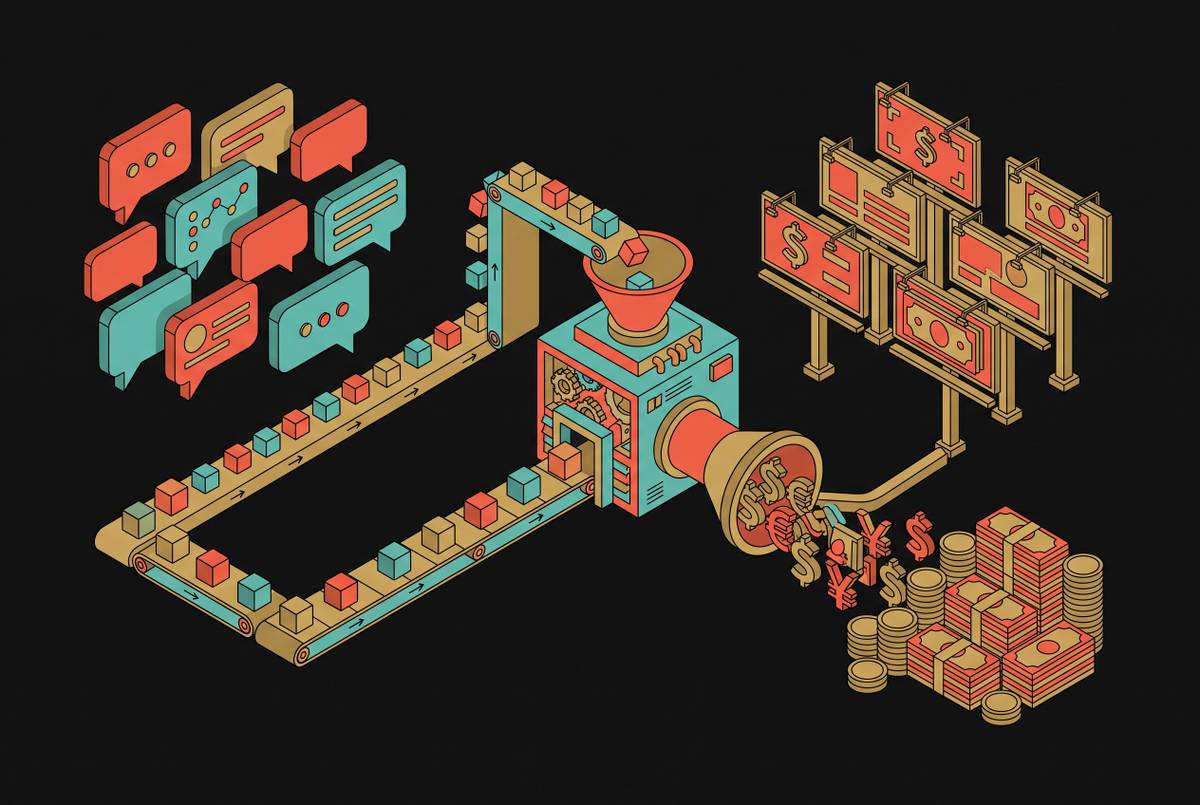
A person who spent eight months talking to an AI companion app, building what felt like a continuous relationship across hundreds of sessions, opens the app one morning to a banner announcing the company has filed for Chapter 11. The conversation history, the voice recordings, the persona configuration tuned over months of small corrections: none of it is covered by anything the user remembers agreeing to. That moment, repeated across productivity tools, voice cloning services, and companion apps throughout 2026, is the real subject of this piece. User data accumulated inside an AI product, whether it takes the form of conversations, voice recordings, behavioral logs, or uploaded files, does not evaporate when the company behind it shuts down or gets sold. It becomes an asset, one that moves with the company into whatever comes next. Acquirers in these deals are rarely buying revenue alone. They are buying proprietary datasets, trained models, behavioral logs, and distribution, and in many cases the user data is the primary thing changing hands in the transaction. The privacy policies that users clicked through were written to govern normal operations, not insolvency or acquisition, and the space between what users thought they agreed to and what those policies actually permit under financial distress is where the exposure lives.
The AI Startup Failure Wave and Stranded User Data
Most AI startups that fail do so for a structural reason that has little to do with bad execution and everything to do with what they were built on. The dominant cause of death is what's known as the "thin wrapper" problem: a product whose entire function amounts to a prompt, an interface, and a call to a third-party foundation model. What remains once the model provider is stripped away is the real question. If the honest answer is a user interface and a system prompt, the company holds no durable asset of its own, and once a foundation model provider ships a comparable feature natively, the startup has no response available. Trade press estimates put the projected failure rate for wrapper-style AI companies near 80 percent by the end of 2026. If two years of user activity generated no proprietary data and created no workflow lock-in, such a company has almost nothing to sell except, possibly, the data its users left behind. At the same moment, the acquisition market is accelerating: global M&A deal value hit its second-highest total on record in 2025, and nearly half of all technology deals carried an AI component, driven by acquirers who find it faster and cheaper to buy AI capability than to build it from scratch. A large number of failing companies sit on user datasets while a well-capitalized buyer market actively looks for exactly that kind of asset; bankruptcy law supplies the mechanism to move it from one side to the other.
The three failure modes that produce three different data outcomes
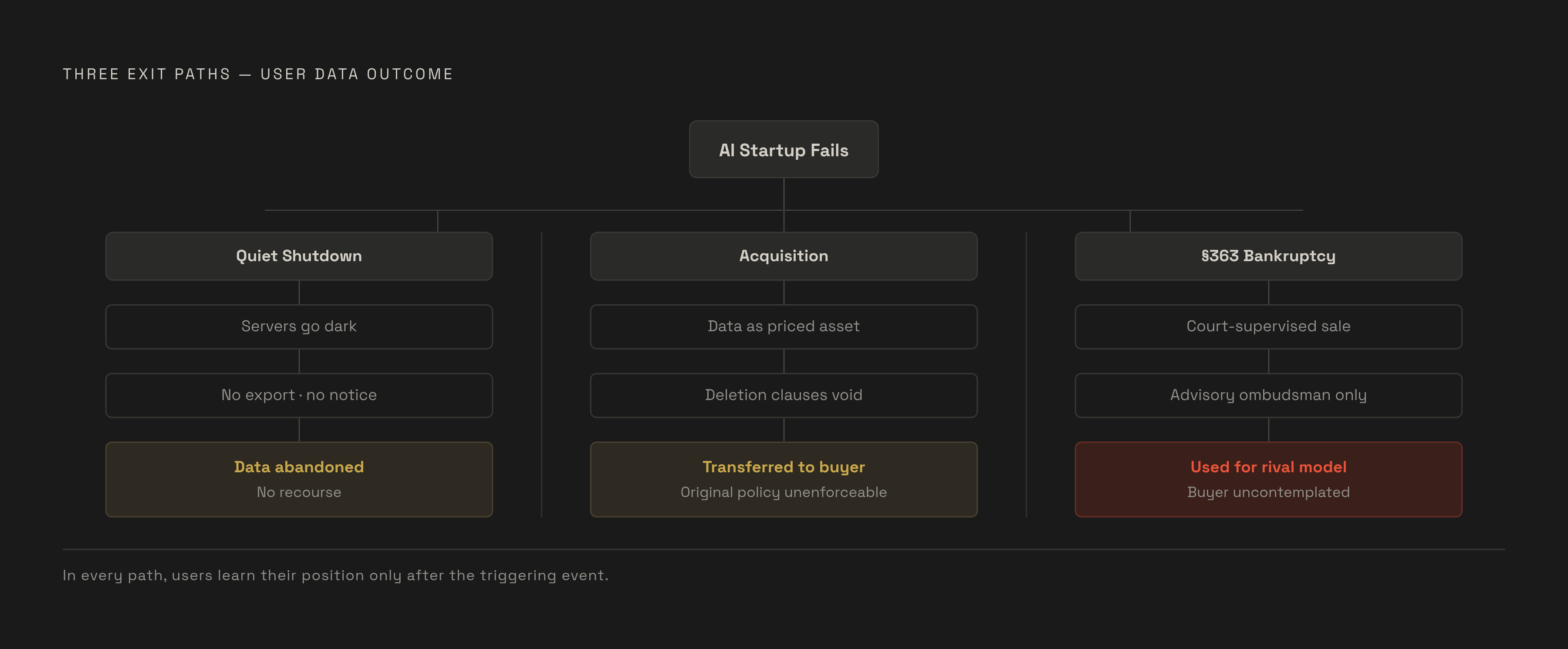
What happens to a user's information depends almost entirely on which of three paths the company takes on its way out. The first is the quiet shutdown: the company simply stops operating, the domain lapses, the servers go dark, and there is no formal export window, no deletion notice, and no successor entity to ask. A meaningful share of genuine product deaths follow this path, and the result for users is a lack of recourse paired with a lack of clarity about whether their data was deleted or just abandoned on some server nobody is paying to maintain. The second is acquisition, where the data transfers to a buyer as a priced asset, often governed by a privacy policy materially different from the one the user originally agreed to. Deletion clauses and service-level commitments in the original terms become aspirational once insolvency proceedings start, because a company in bankruptcy cannot honor contractual promises that conflict with a trustee's legal obligation to maximize asset value for creditors. The third path, a court-supervised bankruptcy sale, is the most legally complex of the three. A court-supervised sale can move user data to a buyer that the original privacy policy never contemplated, including uses the user could not plausibly have anticipated, such as training a competing company's language model. This path does carry a nominal safeguard in the form of a consumer privacy ombudsman, though that role was built for far simpler transactions than the ones now moving through bankruptcy courts. A commercial layer has grown up around all three paths: firms that specifically broker data and code sales on behalf of failing startups now treat a user dataset as a standard line item in a closure transaction, not an afterthought.
The Spirit Airlines and Character.AI Cases: How Data Transfer Works in Practice
Two cases from 2026 show the range of outcomes in concrete terms, and in neither case did the outcome match what the affected parties expected going in. In August 2026, Google acquired Spirit Airlines' emails, calendar information, chats, documents, spreadsheets, and other business data out of the airline's bankruptcy, stating the purpose was to improve its products and AI models. The dataset includes roughly 100 million emails and hundreds of millions of Microsoft Teams messages, all of it generated by employees as a condition of doing their jobs, under no expectation that it would one day become AI training material. The transaction drew formal objection: 121 US lawmakers raised concerns, and a letter led by Senator Elizabeth Warren and Representative Steven Horsford called on Google to exclude employee information from the deal to the greatest extent possible. A court-appointed privacy ombudsman recommended approving the transaction after excluding personal information belonging to approximately 97 million Spirit customers, and a US bankruptcy court was scheduled to consider the sale on October 14. The employee data at issue, some of it going back decades and including payroll records, tax forms, and internal communications, illustrates what might be called a poisoned asset from both directions: employees never anticipated this use, and the buyer inherits unresolved questions about what it is actually permitted to do with what it purchased.
Character.AI's parent company filed for Chapter 11 bankruptcy on October 12, 2026, to sell the business under court supervision. The app and its paid plans continue running, and the sale is expected to close by late November or early December 2026. The company's privacy policy states that data it collects, including chat communications, voice recordings, and images or videos, could be disclosed in connection with or during negotiations or closing of any merger, sale of company assets, financing, or acquisition. That clause had been sitting in the policy the entire time. Most of the roughly 163 million current and past users never read it as a material risk until the bankruptcy filing made it one. The company told the court its users are not creditors. They will not receive personal notice about the case, since the company characterized emailing all of them as cost-prohibitive.
A third category shows a softer but equally disorienting version of the same pattern. When several Chinese AI companion apps shut down or stripped features in July 2026, users had little or no path to recover conversation histories that in some cases represented years of accumulated interaction. Doubao offered a window running until mid-October 2026 for users to save character data and chat histories, with read-only access before deletion, while Qwen told users to back up their records but offered no migration path, so agent data faces permanent deletion. LOVO AI entered Chapter 7 liquidation, and paying users lost access to their accounts and their generated voiceovers entirely; a voice actors' class action against the company was frozen by the bankruptcy stay. Across all of these cases, the pattern repeats: users found out what their position actually was only after the event that triggered it, not before.
Why the existing legal safeguards weren't designed for AI data
The legal machinery that governs data transfers in bankruptcy was built for datasets far simpler than what AI companies now hold, and applying it to training data raises problems that courts are only beginning to confront. The consumer privacy ombudsman, the primary safeguard in bankruptcy data sales, has no power to block a sale. A court must consider the ombudsman's report, but the recommendations inside it are advisory. In the Spirit Airlines case, the ombudsman recommended approval with carve-outs for customer data, and the sale proceeded to a court hearing on that basis. The ombudsman framework was designed for something like a retail company selling its customer email list, not for the transfer of interwoven AI training datasets, fine-tuned model weights, and behavioral logs where individual data points can no longer be cleanly separated from the trained artifact they helped produce. Once text, conversations, or behavioral patterns have been embedded into model weights, they cannot be extracted cleanly, so the deletion rights a user believes they hold become technically unenforceable after training has occurred.
Privacy policies do contain disclosure clauses permitting data transfer in a sale or merger, but those clauses were drafted with ordinary M&A in mind, not with AI model training as the downstream use. The space between "disclosed in connection with a sale" and "used to train a language model" is exactly where affected users find they have no remedy. A separate category of risk applies specifically to enterprise users: inadvertent privilege transfer. A company's Slack archive, email repository, or internal document system will almost inevitably contain attorney-client privileged communications and third-party trade secrets shared under NDAs, so a bulk AI data sale can move these along without any party involved knowing it happened. The copyright issue compounds the problem further. Many AI companies trained their models on data scraped without licenses, and a body of litigation now testing whether that constitutes infringement has produced early decisions more favorable to plaintiffs than the AI industry initially expected. If a buyer acquires a trained model in bankruptcy, it inherits whatever IP liability was baked into the training process before the sale ever happened. The Electronic Frontier Foundation has stated the underlying principle: using a person's data for a new purpose without first getting their consent describes what happens when a bankrupt company sells its employees' emails to become AI training data.
The "Data as Asset" Framing in Privacy Policy Language
AI product privacy policies routinely carry language permitting data transfer in ways most users never register as a material risk, and that language becomes the operative legal text the moment a company fails. The clause to look for reads something like this: user data "may be transferred or disclosed in connection with a merger, acquisition, sale of assets, or other business transaction." This is the clause that governed the Character.AI bankruptcy filing, and it appears as standard boilerplate across most AI product policies, not as something unique to one company. What the clause does not say is just as important as what it does. It typically says nothing about what the acquirer is permitted to do with the data once it changes hands, whether training AI models counts as an included use, whether users will be notified before or after the transfer takes place, or whether there is any opt-out right.
A second clause governs data retention and deletion: how long data survives after a user deletes an account. In ordinary operation, this timeline reflects company policy. In insolvency, it becomes subject to a trustee's discretion instead. A third clause involves training data disclosure. California's AB 2013 now requires generative AI developers to disclose the sources of their training data, which turns data provenance from an internal matter into a published document and creates a paper trail that can later reveal whether a user's data was fed into a model. One might assume that export tools solve the underlying problem, since a user who can download their data retains some control. But an export is not the same thing as ownership of that data in any usable form. Export formats are frequently raw dumps that strip out structure, connections, and remembered context, and a clean export usually cannot be imported into a competing product even when one exists. In the Character.AI case, the export process itself takes three to four weeks, longer than some shutdown windows give users to act.
What Users Can Do Before and After a Failure Event
The most effective action a user can take happens before any failure event occurs, because post-announcement windows tend to be short, export queues fill quickly, and a company's infrastructure is often already degrading by the time a shutdown becomes public. Before anything happens, the habits that matter are ongoing ones. Reading the acquisition and sale clause in any AI product's privacy policy before investing significant personal data into the product is a reasonable first filter: broad transfer language with no restriction on downstream use is a signal worth weighing seriously. Using the data export feature on a regular schedule, treating it as a standing backup rather than a tool reached for only once a crisis is announced, protects against exactly the kind of compressed timeline that Character.AI users faced. Enterprise users have a sharper lever available: negotiating data processing agreements that specify deletion obligations surviving insolvency and that restrict use of the data for AI training, since standard SaaS contracts do not include these terms by default and they have to be added deliberately. The volume of sensitive data going into a given product should be proportionate to actual confidence in that company's stability; a startup with no disclosed investors, no clear revenue model, and a thin-wrapper architecture is structurally more likely to end up in one of the failure modes described earlier.
Once a shutdown or acquisition has actually been announced, the calculus shifts to speed. Request a data export immediately rather than waiting to see how the situation develops, because in the Character.AI case the export process takes three to four weeks and the download link expires seven days after the email arrives, so starting late can mean missing the window. Documenting what data existed in the system before it potentially disappears, through screenshots of conversations, records of uploaded files, or notes on voice recordings and persona configurations, creates a baseline that matters if a dispute arises later. For services holding irreplaceable personal recordings, the kind of scenario a service like HereAfter AI represents, contacting support in writing immediately and keeping a paper trail of that request matters precisely because there is no guarantee the export system will still be functional by the time a user gets around to it. Where a bankruptcy filing is involved, the court docket is public, and both the data asset schedule describing what is being sold and the ombudsman's report describing what protections apply are documents an affected user can actually read.
Some options remain even after a transfer has already occurred. Filing a complaint with the relevant data protection authority is a live option if the new owner's use of the data was not disclosed in the original privacy policy; regulators in California, Texas, Illinois, and the EU are actively scrutinizing AI data practices, and a documented change of use is a viable basis for complaint. Deletion rights under the CCPA and GDPR attach to the data subject rather than to the original controller, so the acquiring company may still be obligated to honor a deletion request even though it was not the entity the user originally dealt with. For employees whose employer's data was sold, the scenario Spirit Airlines employees found themselves in, the ombudsman process combined with congressional pressure produced real changes to what was ultimately included in the transaction: public pressure and regulatory contact retain value even after a sale has been approved.
How an AI product's architecture determines how much of this risk is avoidable
Everything described in this piece, from the ombudsman process to the Section 363 sale to the acquisition clause buried in a privacy policy, operates on data that a company actually holds. These mechanisms can only act on data a company actually collected. That distinction is not theoretical. The Spirit Airlines case, the Character.AI filing, and the Chinese companion app shutdowns all share the same underlying driver: the exposure in each case is a direct function of how much data the company accumulated and retained on its own infrastructure over time. A product designed so that user data never reaches or persists on the vendor's servers simply has no data asset for a trustee to schedule, an ombudsman to review, or an acquirer to price into a deal. Privacy-preserving AI architecture, built from the start so that user information stays with the user rather than accumulating on the provider's side, removes the "data as asset" problem at its source rather than managing it after the fact through policy language.
This reframes the question a user should be asking when evaluating any AI product. The privacy policy answers one question: what the company says it will do. It does not answer a second, more durable question: what the architecture of the product actually allows it to do, regardless of what the policy promises. A policy that commits never to sell user data is only as reliable as the company's solvency, and solvency is precisely what AI startups in the thin-wrapper category cannot guarantee. An architecture that structurally cannot accumulate a user's data, by contrast, offers a guarantee no future policy change, acquisition, or bankruptcy filing can undo. Where a user chooses to put their data is, in that sense, itself a form of protection, independent of whatever terms a company might rewrite under financial pressure.